枼 (yè) means "Leaf (ancient form of 叶)." in Chinese. It has 9 strokes with the radical 木.
Rated 4/5 in difficulty (challenging).
Appears in 3+ common words including 枼枼 (yè yè), 枼子 (yè zi), 枼落 (yè luò).
Due to its 9 strokes, Hanzi Writer's error detection shows 枼 requires focused practice — most learners need 10+ attempts for consistent accuracy.
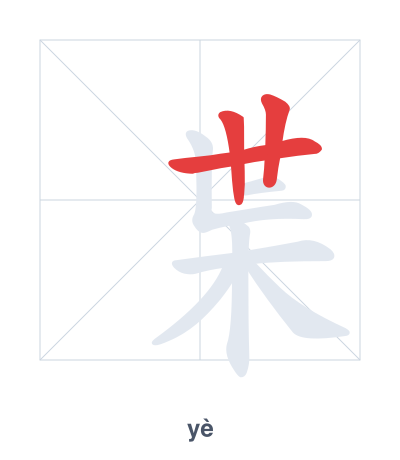
Open Hanzi Writer to see the animated stroke order and practice writing 枼 with real-time feedback.
The character 枼 (yè) is written with 9 strokes. Follow the standard Chinese stroke order: top to bottom, left to right, outside before inside. The radical 木 is one of its key components.
Practice the correct stroke order with the Hanzi Writer app to see animated stroke-by-stroke guidance with real-time feedback.
枼 means Leaf (ancient form of 叶)..
枼 is an ancient pictograph of a leaf on a tree. It combines 木 (tree) with a top part that originally depicted leaves or a leafy branch, later stylized into the shape 世. This character was the original form for 'leaf' before being replaced by 葉 and simplified to 叶.
💡 Memory Tip: Picture a tree (木) wearing a leafy crown shaped like the character 世, as if the leaf is a tiny world resting on the branch.
枼枼是古语。
yè yè shì gǔ yǔ
'Yeye' is an archaic term.
枼子是叶的古字。
yè zi shì yè de gǔ zì
'Ye' (枼) is the ancient character for leaf (叶).
枼落知秋。
yè luò zhī qiū
The falling of a leaf signals the arrival of autumn (ancient form).
Open Hanzi Writer to see the animated stroke order and practice writing 枼 with real-time feedback.
✨ Animated stroke order · Handwriting recognition · HSK-graded practice · Free to use
枼 is composed of the radical 木 (tree) on top and a phonetic component 世 (shì) below. The tree radical connects it to leaves, as leaves grow on trees. The overall structure suggests a flat, thin object like a leaf, matching its ancient meaning.