眩 (xuàn) means "dizzy; dazzled" in Chinese. It has 10 strokes with the radical 目.
Rated 4.2/5 in difficulty (advanced).
Appears in 3+ common words including 眩晕 (xuàn yūn), 头眩 (tóu xuàn), 目眩 (mù xuàn).
Due to its 10 strokes, Hanzi Writer's error detection shows 眩 requires focused practice — most learners need 10+ attempts for consistent accuracy.
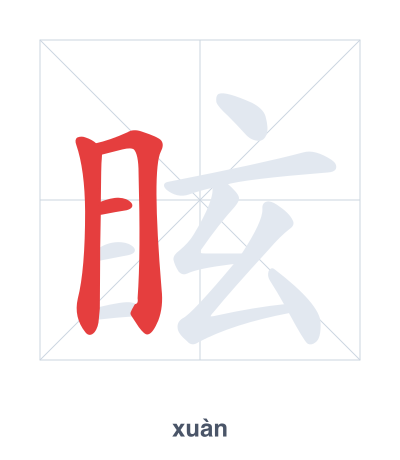
Open Hanzi Writer to see the animated stroke order and practice writing 眩 with real-time feedback.
The character 眩 (xuàn) is written with 10 strokes. Follow the standard Chinese stroke order: top to bottom, left to right, outside before inside. The radical 目 is one of its key components.
Practice the correct stroke order with the Hanzi Writer app to see animated stroke-by-stroke guidance with real-time feedback.
眩 means dizzy; dazzled.
The character 眩 combines the eye radical 目 with 玄 (xuán), which originally depicted a dark, mysterious thread. The eye encountering something obscure or swirling leads to a sense of dizziness or being dazzled, as if the vision is clouded by darkness or confusion.
💡 Memory Tip: Imagine your eye (目) staring into a dark, spinning whirlpool (玄) until you feel completely dizzy.
他感到一阵眩晕。
tā gǎn dào yī zhèn xuàn yūn
He felt a wave of dizziness.
我觉得有点头眩。
wǒ jué de yǒu diǎn tóu xuàn
I feel a bit lightheaded.
这里的灯光让人目眩。
zhè lǐ de dēng guāng ràng rén mù xuàn
The lights here are dazzling.
Open Hanzi Writer to see the animated stroke order and practice writing 眩 with real-time feedback.
✨ Animated stroke order · Handwriting recognition · HSK-graded practice · Free to use
眩 is composed of the radical 目 (eye) on the left and 玄 (dark or profound) on the right. The idea is that when your eyes encounter something dark, confusing, or too dazzling, you become dizzy or dazzled.