蚬 (xiǎn) means "clam; corbicula" in Chinese. It has 10 strokes with the radical 虫.
Rated 4.2/5 in difficulty (advanced).
Appears in 3+ common words including 蚬子 (xiǎn zi), 蚬肉 (xiǎn ròu), 蚬汤 (xiǎn tāng).
Due to its 10 strokes, Hanzi Writer's error detection shows 蚬 requires focused practice — most learners need 10+ attempts for consistent accuracy.
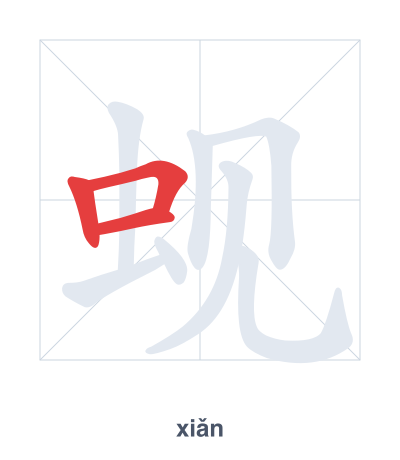
Open Hanzi Writer to see the animated stroke order and practice writing 蚬 with real-time feedback.
The character 蚬 (xiǎn) is written with 10 strokes. Follow the standard Chinese stroke order: top to bottom, left to right, outside before inside. The radical 虫 is one of its key components.
Practice the correct stroke order with the Hanzi Writer app to see animated stroke-by-stroke guidance with real-time feedback.
蚬 means clam; corbicula.
The character 蚬 combines the radical 虫 (insect/creature), indicating it is a type of shellfish, with 见 (to see/appear), which provides the pronunciation xiǎn and also hints that clams often appear visible on riverbeds or sandy shores.
💡 Memory Tip: Imagine a clam (虫) popping out of the sand to 'see' (见) you before quickly snapping shut.
我们去海边捡蚬子。
wǒ men qù hǎi biān jiǎn xiǎn zi
We are going to the seaside to pick up clams.
蚬肉的味道很鲜。
xiǎn ròu de wèi dào hěn xiān
The clam meat tastes very fresh.
这碗蚬汤很好喝。
zhè wǎn xiǎn tāng hěn hǎo hē
This bowl of clam soup is delicious.
Open Hanzi Writer to see the animated stroke order and practice writing 蚬 with real-time feedback.
✨ Animated stroke order · Handwriting recognition · HSK-graded practice · Free to use
蚬 is made of two parts: the left radical 虫, which means insect or small creature, and the right side 见, meaning "to see." The 虫 radical tells you that 蚬 is a type of small animal, specifically a clam or shellfish. The right side 见 may hint at the pronunciation (xiǎn) but does not directly connect to the meaning.