坞 (wù) means "dock / basin / lowland" in Chinese. It has 7 strokes with the radical 土.
Rated 3.5/5 in difficulty (challenging).
Appears in 3+ common words including 船坞 (chuán wù), 好莱坞 (hǎo lái wù), 山坞 (shān wù).
Due to its 7 strokes, Hanzi Writer's error detection shows 坞 requires focused practice — most learners need 10+ attempts for consistent accuracy.
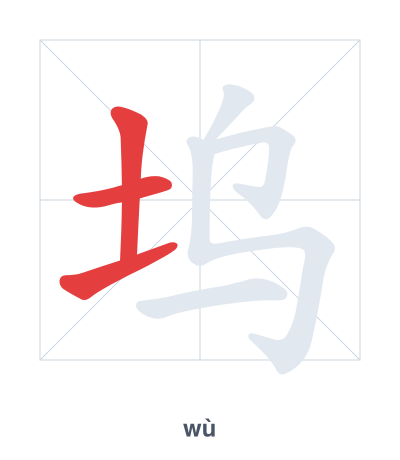
Open Hanzi Writer to see the animated stroke order and practice writing 坞 with real-time feedback.
The character 坞 (wù) is written with 7 strokes. Follow the standard Chinese stroke order: top to bottom, left to right, outside before inside. The radical 土 is one of its key components.
Practice the correct stroke order with the Hanzi Writer app to see animated stroke-by-stroke guidance with real-time feedback.
坞 means dock / basin / lowland.
坞 combines the radical 土 (earth, ground) with 乌 (wū, crow), which provides pronunciation. The character originally referred to a small defensive enclosure or low-lying area built from earth, later extended to mean a dock or basin sheltered by land.
💡 Memory Tip: Picture a muddy dock (土) where a black crow (乌) perches on a low wall, guarding the basin.
船停在船坞里。
chuán tíng zài chuán wù lǐ
The ship is in the dry dock.
他想去好莱坞看电影。
tā xiǎng qù hǎo lái wù kàn diàn yǐng
He wants to go to Hollywood to watch a movie.
山坞里住着几家人。
shān wù lǐ zhù zhe jǐ jiā rén
A few families live in the mountain valley.
Open Hanzi Writer to see the animated stroke order and practice writing 坞 with real-time feedback.
✨ Animated stroke order · Handwriting recognition · HSK-graded practice · Free to use
坞 is made of the radical 土 (earth) on the left, which hints at the meaning of land or low-lying ground. The right part 乌 (wū, crow) gives the sound wù, making it a phono-semantic compound. Together, they form the idea of a basin or dock built from earth.