浯 (wú) means "Wu (often used in place names)" in Chinese. It has 10 strokes with the radical 氵.
Rated 4.2/5 in difficulty (advanced).
Appears in 3+ common words including 浯溪 (wú xī), 浯屿 (wú yǔ), 浯水 (wú shuǐ).
Due to its 10 strokes, Hanzi Writer's error detection shows 浯 requires focused practice — most learners need 10+ attempts for consistent accuracy.
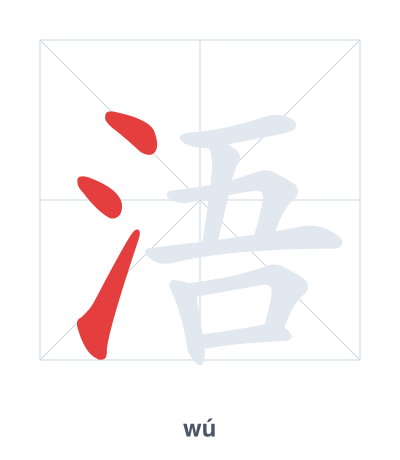
Open Hanzi Writer to see the animated stroke order and practice writing 浯 with real-time feedback.
The character 浯 (wú) is written with 10 strokes. Follow the standard Chinese stroke order: top to bottom, left to right, outside before inside. The radical 氵 is one of its key components.
Practice the correct stroke order with the Hanzi Writer app to see animated stroke-by-stroke guidance with real-time feedback.
浯 means Wu (often used in place names).
浯 is a phono-semantic compound: the radical 氵 indicates water, and 吾 (wú) provides the pronunciation. It originally referred to the name of a river (浯水) in ancient China, and today it appears in place names like 浯溪.
💡 Memory Tip: Picture a river (氵) where someone says 'I' (吾) while pointing at five (五) mouths (口) drinking from it.
浯溪的风景很美。
wú xī de fēng jǐng hěn měi
The scenery of Wuxi is very beautiful.
浯屿是一个小岛。
wú yǔ shì yí gè xiǎo dǎo
Wuyu is a small island.
浯水流向远方。
wú shuǐ liú xiàng yuǎn fāng
The Wushui River flows into the distance.
Open Hanzi Writer to see the animated stroke order and practice writing 浯 with real-time feedback.
✨ Animated stroke order · Handwriting recognition · HSK-graded practice · Free to use
浯 is made of the water radical 氵 on the left and the character 吾 (wú, meaning 'I' or 'my') on the right. This is a phono-semantic compound where 吾 provides the pronunciation, and 氵 indicates the meaning relates to water—specifically used in place names like streams or rivers.