巫 (wū) means "shaman; witch; wizard" in Chinese. It has 7 strokes with the radical 工, and is HSK Level 7.
Rated 3.5/5 in difficulty (challenging).
Harder than 17% of HSK Level 7 characters.
Appears in 3+ common words including 巫师 (wū shī), 女巫 (nǚ wū), 巫婆 (wū pó).
Due to its 7 strokes, Hanzi Writer's error detection shows 巫 requires focused practice — most learners need 10+ attempts for consistent accuracy.
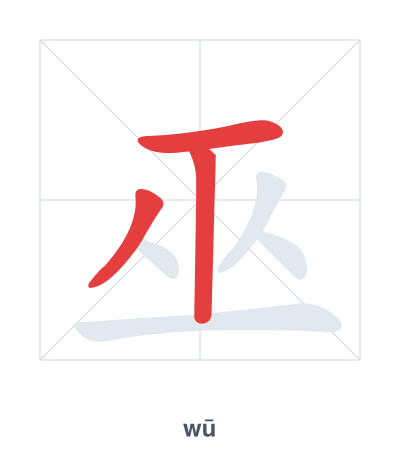
Open Hanzi Writer to see the animated stroke order and practice writing 巫 with real-time feedback.
The character 巫 (wū) is written with 7 strokes. Follow the standard Chinese stroke order: top to bottom, left to right, outside before inside. The radical 工 is one of its key components.
Practice the correct stroke order with the Hanzi Writer app to see animated stroke-by-stroke guidance with real-time feedback.
巫 means shaman; witch; wizard.
As an HSK Level 7 character, 巫 is an intermediate-level character.
巫 originally depicted two persons (the top and bottom '人' shapes) dancing on either side of a central pillar or sacred work (工), representing shamans performing rituals to connect heaven and earth. The ancient oracle bone form showed crossed lines or jade pieces, symbolizing the shaman's tools for divination.
💡 Memory Tip: Picture two shamans on top and bottom of a workbench (工) casting a spell together.
电影里有一个巫师。
diàn yǐng lǐ yǒu yí gè wū shī
There is a wizard in the movie.
小女孩想当女巫。
xiǎo nǚ hái xiǎng dāng nǚ wū
The little girl wants to be a witch.
那个巫婆很可怕。
nà ge wū pó hěn kě pà
That witch is very scary.
Open Hanzi Writer to see the animated stroke order and practice writing 巫 with real-time feedback.
✨ Animated stroke order · Handwriting recognition · HSK-graded practice · Free to use
巫 is composed of two 人 (person) radicals on top and the radical 工 (work) at the bottom. The two people represent shamanic practitioners communicating, while 工 suggests their ritual work or tools, forming the idea of a shaman or wizard.