硙 (wéi) means "stone mill" in Chinese. It has 11 strokes with the radical 石.
Rated 4.2/5 in difficulty (advanced).
Appears in 3+ common words including 石硙 (shí wéi), 硙磨 (wéi mó), 硙硙 (wéi wéi).
Due to its 11 strokes, Hanzi Writer's error detection shows 硙 requires focused practice — most learners need 10+ attempts for consistent accuracy.
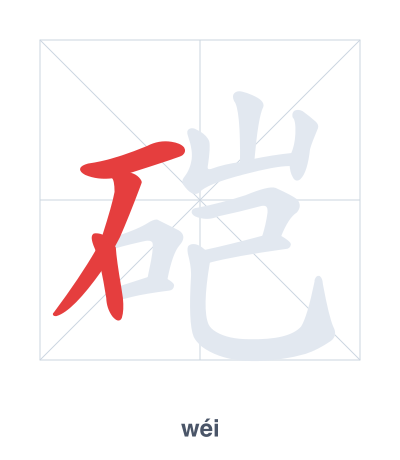
Open Hanzi Writer to see the animated stroke order and practice writing 硙 with real-time feedback.
The character 硙 (wéi) is written with 11 strokes. Follow the standard Chinese stroke order: top to bottom, left to right, outside before inside. The radical 石 is one of its key components.
Practice the correct stroke order with the Hanzi Writer app to see animated stroke-by-stroke guidance with real-time feedback.
硙 means stone mill.
硙 is a phono-semantic compound: the radical 石 (stone) indicates the material, while the phonetic component 危 (wēi, meaning 'precarious') also hints at the mill's two stacked stones that grind against each other in a precarious balance.
💡 Memory Tip: Imagine a dangerous (危) stone (石) wheel teetering on top of another, grinding grain into flour.
他在用石硙磨面。
tā zài yòng shí wéi mò miàn
He is grinding flour with a stone mill.
硙磨的声音很大。
wéi mó de shēng yīn hěn dà
The sound of the stone mill is very loud.
山上白雪硙硙。
shān shàng bái xuě wéi wéi
The mountain is covered with white snow.
Open Hanzi Writer to see the animated stroke order and practice writing 硙 with real-time feedback.
✨ Animated stroke order · Handwriting recognition · HSK-graded practice · Free to use
硙 is made of two parts: the left radical 石 (stone) and the right component 豈 (which indicates the sound and originally meant 'tall'). The stone radical shows that a mill is made of stone, while the right side adds phonetic value. Together, they create the meaning 'stone mill'.