辋 (wǎng) means "Wheel rim" in Chinese. It has 12 strokes with the radical 车.
Rated 4.2/5 in difficulty (advanced).
Appears in 3+ common words including 车辋 (chē wǎng), 辋川 (wǎng chuān), 辋子 (wǎng zi).
Due to its 12 strokes, Hanzi Writer's error detection shows 辋 requires focused practice — most learners need 10+ attempts for consistent accuracy.
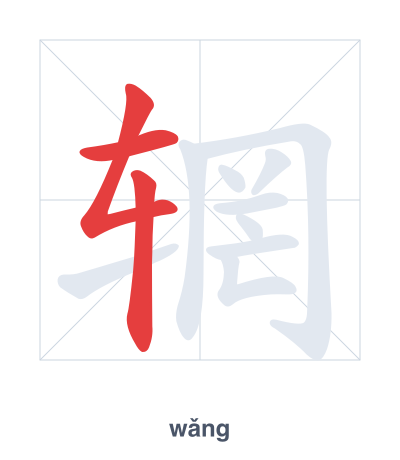
Open Hanzi Writer to see the animated stroke order and practice writing 辋 with real-time feedback.
The character 辋 (wǎng) is written with 12 strokes. Follow the standard Chinese stroke order: top to bottom, left to right, outside before inside. The radical 车 is one of its key components.
Practice the correct stroke order with the Hanzi Writer app to see animated stroke-by-stroke guidance with real-time feedback.
辋 means Wheel rim.
辋 is a phono-semantic compound: the radical 车 (vehicle/wheel) indicates the meaning relates to wheels, and 罔 (wǎng) provides the pronunciation. The character specifically refers to the rim of a wheel, the outer circular band.
💡 Memory Tip: Picture a wheel (车) whose rim is wrapped in a spider's net (罔), catching debris as it rolls.
车辋是轮子的外圈。
chē wǎng shì lún zi de wài quān
The rim is the outer part of a wheel.
辋川是一个美丽的地方。
wǎng chuān shì yí gè měi lì de dì fāng
Wangchuan is a beautiful place.
这个木头辋子坏了。
zhè ge mù tou wǎng zi huài le
This wooden wheel rim is broken.
Open Hanzi Writer to see the animated stroke order and practice writing 辋 with real-time feedback.
✨ Animated stroke order · Handwriting recognition · HSK-graded practice · Free to use
辋 is made of 车 (vehicle) on the left and 罔 (wǎng, a phonetic component) on the right. The 车 radical gives the meaning of a wheel-related part, so 辋 specifically refers to the rim that holds the tire on a wheel. The right part 罔 primarily provides pronunciation but also hints at a surrounding shape.