汪 (wāng) means "Vast / (sound of a dog bark)" in Chinese. It has 7 strokes with the radical 氵, and is HSK Level 7.
Rated 3.5/5 in difficulty (challenging).
Harder than 19% of HSK Level 7 characters.
Appears in 3+ common words including 汪汪 (wāng wāng), 汪洋 (wāng yáng), 姓汪 (xìng wāng).
Due to its 7 strokes, Hanzi Writer's error detection shows 汪 requires focused practice — most learners need 10+ attempts for consistent accuracy.
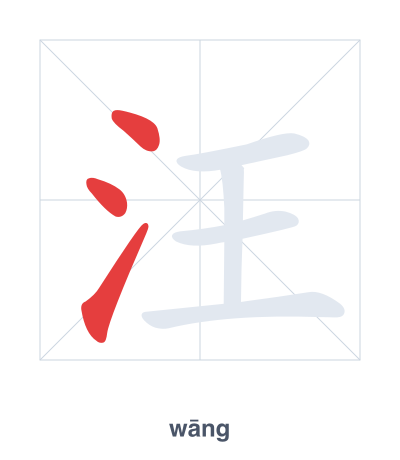
Open Hanzi Writer to see the animated stroke order and practice writing 汪 with real-time feedback.
The character 汪 (wāng) is written with 7 strokes. Follow the standard Chinese stroke order: top to bottom, left to right, outside before inside. The radical 氵 is one of its key components.
Practice the correct stroke order with the Hanzi Writer app to see animated stroke-by-stroke guidance with real-time feedback.
汪 means Vast / (sound of a dog bark).
As an HSK Level 7 character, 汪 is an intermediate-level character.
汪 combines the water radical 氵 with 王 (king), originally depicting deep, vast waters like a 'king of water'. The dog bark meaning is a phonetic loan, as 汪 sounds like a dog's 'wang' bark.
💡 Memory Tip: A king (王) stands in a vast pool of water (氵), barking 'wang wang' like a dog.
小狗汪汪地叫。
xiǎo gǒu wāng wāng dì jiào
The puppy is barking 'woof woof'.
大海是一片汪洋。
dà hǎi shì yī piàn wāng yáng
The sea is a vast ocean.
我的老师姓汪。
wǒ de lǎo shī xìng wāng
My teacher's surname is Wang.
Open Hanzi Writer to see the animated stroke order and practice writing 汪 with real-time feedback.
✨ Animated stroke order · Handwriting recognition · HSK-graded practice · Free to use
汪 is made of the water radical 氵 on the left and the character 王 (king) on the right. The water radical gives the meaning of liquid or vastness, while 王 adds sound and suggests something grand; together they create the sense of a vast body of water. This also explains why 汪 can mean "vast" and why it is used for the sound of a dog's bark — the character was borrowed for that sound.