佗 (tuó) means "a surname; other (archaic)" in Chinese. It has 7 strokes with the radical 亻.
Rated 3.2/5 in difficulty (challenging).
Appears in 3+ common words including 华佗 (huà tuó), 佗佗 (tuó tuó), 委佗 (wěi tuó).
Due to its 7 strokes, Hanzi Writer's error detection shows 佗 requires focused practice — most learners need 10+ attempts for consistent accuracy.
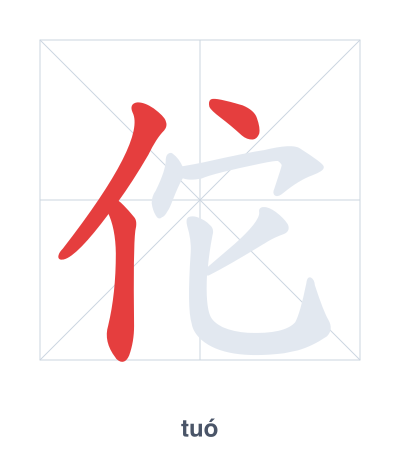
Open Hanzi Writer to see the animated stroke order and practice writing 佗 with real-time feedback.
The character 佗 (tuó) is written with 7 strokes. Follow the standard Chinese stroke order: top to bottom, left to right, outside before inside. The radical 亻 is one of its key components.
Practice the correct stroke order with the Hanzi Writer app to see animated stroke-by-stroke guidance with real-time feedback.
佗 means a surname; other (archaic).
佗 combines the person radical 亻 with 它 (a pictograph of a snake, anciently meaning 'other'). It originally referred to 'another person' or 'someone else,' later used as a surname.
💡 Memory Tip: Imagine a person (亻) standing with a snake (它) coiled around their leg, reminding you 'other' people have 'other' pets.
华佗是古代名医。
huà tuó shì gǔ dài míng yī
Hua Tuo was a famous ancient physician.
他走路的样子很佗佗。
tā zǒu lù de yàng zi hěn tuó tuó
He walks in a leisurely and elegant manner.
这种步态叫委佗。
zhè zhǒng bù tài jiào wěi tuó
This gait is called a graceful walk.
Open Hanzi Writer to see the animated stroke order and practice writing 佗 with real-time feedback.
✨ Animated stroke order · Handwriting recognition · HSK-graded practice · Free to use
佗 is made of the person radical 亻 on the left and the character 它 (tuō, meaning 'it' or 'other') on the right. Together, they suggest the idea of 'another person,' which connects to its archaic meaning of 'other.' In modern use, 佗 is mainly a surname and does not carry this literal meaning.