砼 (tóng) means "Concrete" in Chinese. It has 10 strokes with the radical 石.
Rated 4.2/5 in difficulty (advanced).
Appears in 3+ common words including 砼结构 (tóng jié gòu), 砼路面 (tóng lù miàn), 砼搅拌 (tóng jiǎo bàn).
Due to its 10 strokes, Hanzi Writer's error detection shows 砼 requires focused practice — most learners need 10+ attempts for consistent accuracy.
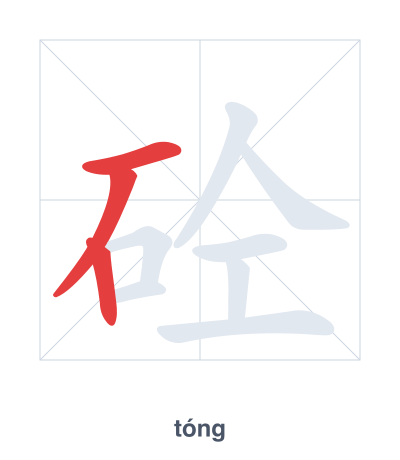
Open Hanzi Writer to see the animated stroke order and practice writing 砼 with real-time feedback.
The character 砼 (tóng) is written with 10 strokes. Follow the standard Chinese stroke order: top to bottom, left to right, outside before inside. The radical 石 is one of its key components.
Practice the correct stroke order with the Hanzi Writer app to see animated stroke-by-stroke guidance with real-time feedback.
砼 means Concrete.
砼 is a modern compound character coined in the 1950s for 'concrete'. It combines 石 (stone) with 仝 (tóng, meaning 'same' and also serving as a phonetic), suggesting 'man-made stone'—a material that hardens like rock through human work. The structure literally reads as 'stone + same' to imply artificial stone.
💡 Memory Tip: Imagine a worker (人) doing hard work (工) to mix stone (石) into concrete—the same (仝) as natural rock.
这个房子是砼结构。
zhè ge fáng zi shì tóng jié gòu
This house has a concrete structure.
砼路面很坚固。
tóng lù miàn hěn jiān gù
Concrete pavement is very sturdy.
工人在进行砼搅拌。
gōng rén zài jìn xíng tóng jiǎo bàn
The worker is mixing concrete.
Open Hanzi Writer to see the animated stroke order and practice writing 砼 with real-time feedback.
✨ Animated stroke order · Handwriting recognition · HSK-graded practice · Free to use
砼 is composed of the radical 石 (stone) on the left, and the phonetic component 仝 (tóng) on the right. 仝 itself is made of 人 (person) and 工 (work), so 砼 literally means "man-made stone," which is exactly what concrete is.