锑 (tī) means "Antimony" in Chinese. It has 12 strokes with the radical 钅.
Rated 4.2/5 in difficulty (advanced).
Appears in 3+ common words including 锑矿 (tī kuàng), 锑合金 (tī hé jīn), 锑粉 (tī fěn).
Due to its 12 strokes, Hanzi Writer's error detection shows 锑 requires focused practice — most learners need 10+ attempts for consistent accuracy.
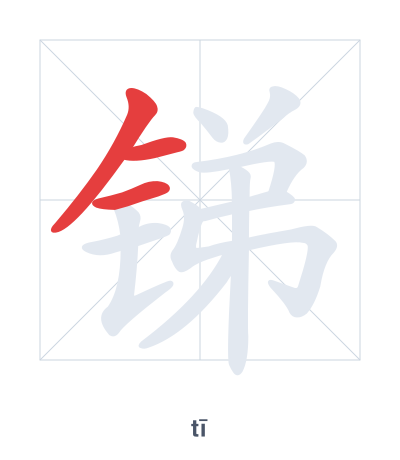
Open Hanzi Writer to see the animated stroke order and practice writing 锑 with real-time feedback.
The character 锑 (tī) is written with 12 strokes. Follow the standard Chinese stroke order: top to bottom, left to right, outside before inside. The radical 钅 is one of its key components.
Practice the correct stroke order with the Hanzi Writer app to see animated stroke-by-stroke guidance with real-time feedback.
锑 means Antimony.
锑 is a phono-semantic compound: the radical 钅 (metal) indicates it's a metallic element, while the component 弟 (younger brother) provides the pronunciation tī (historically related to the sound of 'younger brother' in some dialects). The character was created when antimony was classified as a metal in Chinese chemistry.
💡 Memory Tip: Picture a younger brother (弟) proudly holding up a shiny, toxic metal (钅) bar — that's antimony, the mischievous element he shouldn't be playing with.
中国有丰富的锑矿资源。
zhōng guó yǒu fēng fù de tī kuàng zī yuán
China has rich antimony ore resources.
这种零件由锑合金制成。
zhè zhǒng líng jiàn yóu tī hé jīn zhì chéng
This part is made of antimony alloy.
实验中需要用到锑粉。
shí yàn zhōng xū yào yòng dào tī fěn
Antimony powder is needed in the experiment.
Open Hanzi Writer to see the animated stroke order and practice writing 锑 with real-time feedback.
✨ Animated stroke order · Handwriting recognition · HSK-graded practice · Free to use
锑 combines the radical 钅 (jīn, meaning 'gold/metal') on the left with the phonetic component 弟 (dì, meaning 'younger brother') on the right. The metal radical hints that antimony is a metallic element, while 弟 provides the sound 'tī' rather than contributing meaning.