檀 (tán) means "sandalwood; hardwood" in Chinese. It has 17 strokes with the radical 木.
Rated 4.2/5 in difficulty (advanced).
Appears in 3+ common words including 檀香 (tán xiāng), 紫檀 (zǐ tán), 檀木 (tán mù).
Due to its 17 strokes, Hanzi Writer's error detection shows 檀 requires focused practice — most learners need 10+ attempts for consistent accuracy.
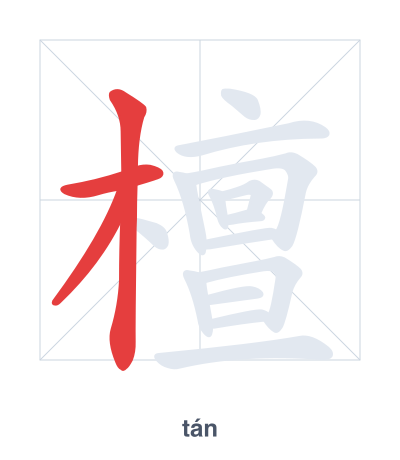
Open Hanzi Writer to see the animated stroke order and practice writing 檀 with real-time feedback.
The character 檀 (tán) is written with 17 strokes. Follow the standard Chinese stroke order: top to bottom, left to right, outside before inside. The radical 木 is one of its key components.
Practice the correct stroke order with the Hanzi Writer app to see animated stroke-by-stroke guidance with real-time feedback.
檀 means sandalwood; hardwood.
檀 is a phono-semantic compound: the radical 木 (tree) indicates it's a type of wood, while 亶 (tán) provides the pronunciation and originally meant 'sincere' but here acts as a phonetic. Sandalwood is a fragrant hardwood, and the character visually combines a tree with a complex sound component.
💡 Memory Tip: Picture a tree (木) that is so sincere (亶) that it produces the sweetest sandalwood incense.
檀香的味道很好闻。
tán xiāng de wèi dào hěn hǎo wén
Sandalwood smells very good.
紫檀家具非常贵。
zǐ tán jiā jù fēi cháng guì
Red sandalwood furniture is very expensive.
这是檀木做的桌子。
zhè shì tán mù zuò de zhuō zi
This is a sandalwood table.
Open Hanzi Writer to see the animated stroke order and practice writing 檀 with real-time feedback.
✨ Animated stroke order · Handwriting recognition · HSK-graded practice · Free to use
The left part is 木 (mù), the radical for wood or trees, showing that 檀 refers to a type of tree. The right part is 亶 (dǎn), which gives the sound and originally meant 'sincere', but here it does not directly add to the tree meaning. Together, 檀 means sandalwood, a tree valued for its fragrant wood.