倠 (suī) means "an ancient character" in Chinese. It has 10 strokes with the radical 人.
Rated 3.9/5 in difficulty (challenging).
Appears in 1+ common words including 倠 (suī).
Due to its 10 strokes, Hanzi Writer's error detection shows 倠 requires focused practice — most learners need 10+ attempts for consistent accuracy.
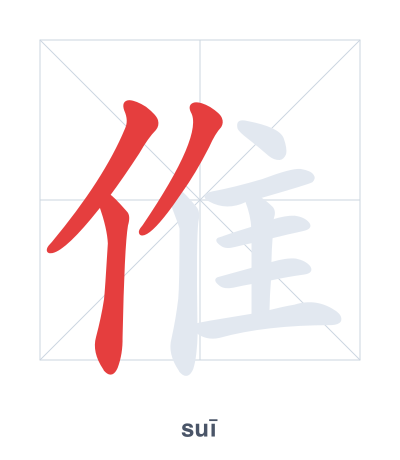
Open Hanzi Writer to see the animated stroke order and practice writing 倠 with real-time feedback.
The character 倠 (suī) is written with 10 strokes. Follow the standard Chinese stroke order: top to bottom, left to right, outside before inside. The radical 人 is one of its key components.
Practice the correct stroke order with the Hanzi Writer app to see animated stroke-by-stroke guidance with real-time feedback.
倠 means an ancient character.
This rare character combines the radical 人 (person) on the left with 隹 (short-tailed bird) on the right, forming a compound that likely depicted a person associated with a bird, perhaps in an ancient name or title.
💡 Memory Tip: Picture a bizarre ancient person (亻) wearing a bird (隹) on their head like a hat, a forgotten fashion from long ago.
倠是一个古字。
suī shì yí gè gǔ zì
'Sui' is an ancient character.
这个字现在不常用。
zhè ge zì xiàn zài bù cháng yòng
This character is not commonly used now.
我不认识这个倠字。
wǒ bù rèn shí zhè ge suī zì
I don't know this character '倠'.
Open Hanzi Writer to see the animated stroke order and practice writing 倠 with real-time feedback.
✨ Animated stroke order · Handwriting recognition · HSK-graded practice · Free to use
倠 is made of the radical 亻 (person) on the left and the component 隹 (short-tailed bird) on the right. Together they form an ancient character that no longer has a clear, modern meaning. The structure shows a person next to a bird, but this combination is now only found in historical records.