姒 (sì) means "elder brother's wife (archaic); a surname" in Chinese. It has 7 strokes with the radical 女.
Rated 3.5/5 in difficulty (challenging).
Appears in 3+ common words including 褒姒 (bāo sì), 姒 (sì), 娣姒 (dì sì).
Due to its 7 strokes, Hanzi Writer's error detection shows 姒 requires focused practice — most learners need 10+ attempts for consistent accuracy.
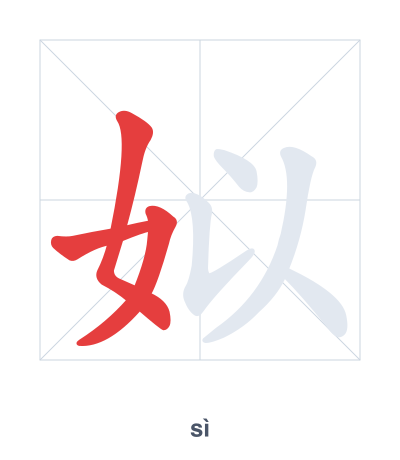
Open Hanzi Writer to see the animated stroke order and practice writing 姒 with real-time feedback.
The character 姒 (sì) is written with 7 strokes. Follow the standard Chinese stroke order: top to bottom, left to right, outside before inside. The radical 女 is one of its key components.
Practice the correct stroke order with the Hanzi Writer app to see animated stroke-by-stroke guidance with real-time feedback.
姒 means elder brother's wife (archaic); a surname.
姒 combines the radical 女 (woman) with 以 (yǐ, 'to use' or 'by means of'), which provides the phonetic component. The character historically referred to an elder brother's wife, a female relative by marriage.
💡 Memory Tip: Picture a woman (女) using (以) a ruler to boss around her husband's younger siblings—she's the elder brother's wife.
褒姒是古代的美女。
bāo sì shì gǔ dài de měi nǚ
Bao Si was a beauty of ancient times.
姒是一个古老的姓。
sì shì yí gè gǔ lǎo de xìng
Si is an ancient surname.
她们是娣姒关系。
tā men shì dì sì guān xì
They are sisters-in-law (wives of brothers).
Open Hanzi Writer to see the animated stroke order and practice writing 姒 with real-time feedback.
✨ Animated stroke order · Handwriting recognition · HSK-graded practice · Free to use
姒 is composed of the radical 女 (woman) on the left and 以 (yǐ) on the right. The 女 radical shows the meaning relates to women, and 以 may hint at the pronunciation sì. Together, they originally referred to an elder brother's wife.