纾 (shū) means "to relieve, to alleviate" in Chinese. It has 7 strokes with the radical 纟.
Rated 3.5/5 in difficulty (challenging).
Appears in 3+ common words including 纾解 (shū jiě), 纾困 (shū kùn), 纾难 (shū nán).
Due to its 7 strokes, Hanzi Writer's error detection shows 纾 requires focused practice — most learners need 10+ attempts for consistent accuracy.
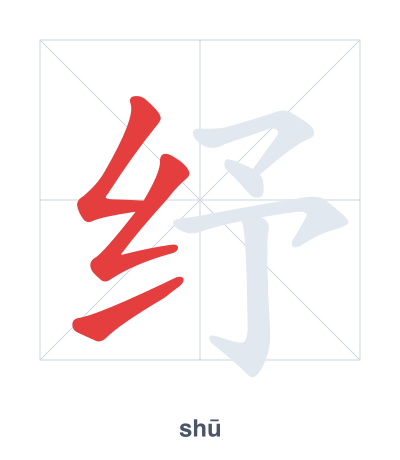
Open Hanzi Writer to see the animated stroke order and practice writing 纾 with real-time feedback.
The character 纾 (shū) is written with 7 strokes. Follow the standard Chinese stroke order: top to bottom, left to right, outside before inside. The radical 纟 is one of its key components.
Practice the correct stroke order with the Hanzi Writer app to see animated stroke-by-stroke guidance with real-time feedback.
纾 means to relieve, to alleviate.
纾 is a compound character combining the silk radical 纟 with 予 (to give). Silk thread was historically used to bind or wrap, and giving (予) a loose thread suggests the action of slackening or easing a tight situation. Thus, the character conveys the idea of relieving or alleviating pressure.
💡 Memory Tip: Imagine giving (予) a tangled silk thread (纟) a gentle tug to loosen its knot and relieve the tension.
听音乐可以纾解压力。
tīng yīn yuè kě yǐ shū jiě yā lì
Listening to music can relieve stress.
政府提供了纾困贷款。
zhèng fǔ tí gōng le shū kùn dài kuǎn
The government provided relief loans.
英雄挺身纾难。
yīng xióng tǐng shēn shū nán
The hero stepped forward to save the day.
Open Hanzi Writer to see the animated stroke order and practice writing 纾 with real-time feedback.
✨ Animated stroke order · Handwriting recognition · HSK-graded practice · Free to use
The left component 纟 is the silk radical, linking the character to threads or fabric. The right component 予 means 'to give' or 'to extend'. Together they suggest loosening or releasing something tight, which leads to the meanings 'to relieve' and 'to alleviate'.