砷 (shēn) means "arsenic" in Chinese. It has 10 strokes with the radical 石.
Rated 4.2/5 in difficulty (advanced).
Appears in 3+ common words including 砷中毒 (shēn zhòng dú), 含砷 (hán shēn), 砷化物 (shēn huà wù).
Due to its 10 strokes, Hanzi Writer's error detection shows 砷 requires focused practice — most learners need 10+ attempts for consistent accuracy.
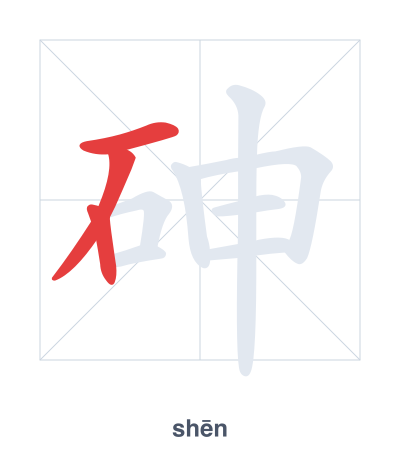
Open Hanzi Writer to see the animated stroke order and practice writing 砷 with real-time feedback.
The character 砷 (shēn) is written with 10 strokes. Follow the standard Chinese stroke order: top to bottom, left to right, outside before inside. The radical 石 is one of its key components.
Practice the correct stroke order with the Hanzi Writer app to see animated stroke-by-stroke guidance with real-time feedback.
砷 means arsenic.
砷 is a phono-semantic compound: 石 (stone/mineral) indicates it is a type of ore, and 申 (shēn) provides the pronunciation. This character was created in modern times to represent the chemical element arsenic, which occurs naturally in certain minerals.
💡 Memory Tip: Picture a stone (石) with a warning cross (申) on it, reminding you that arsenic is a poisonous mineral.
他发生了砷中毒。
tā fā shēng le shēn zhòng dú
He suffered from arsenic poisoning.
这种水里含有砷。
zhè zhǒng shuǐ lǐ hán yǒu shēn
This water contains arsenic.
这是危险的砷化物。
zhè shì wēi xiǎn de shēn huà wù
This is a dangerous arsenide.
Open Hanzi Writer to see the animated stroke order and practice writing 砷 with real-time feedback.
✨ Animated stroke order · Handwriting recognition · HSK-graded practice · Free to use
The character 砷 is made of two parts: the radical 石 (stone) on the left and the phonetic component 申 (shēn) on the right. The radical 石 shows that arsenic is a type of mineral or rock, while 申 gives the pronunciation. Together, they form the character for the element arsenic.