晌 (shǎng) means "midday; afternoon" in Chinese. It has 10 strokes with the radical 日.
Rated 4.2/5 in difficulty (advanced).
Appears in 3+ common words including 晌午 (shǎng wǔ), 半晌 (bàn shǎng), 晌觉 (shǎng jué).
Due to its 10 strokes, Hanzi Writer's error detection shows 晌 requires focused practice — most learners need 10+ attempts for consistent accuracy.
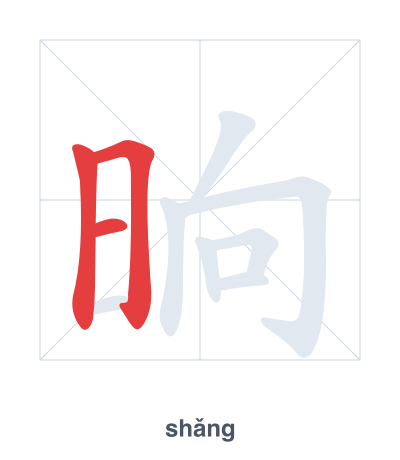
Open Hanzi Writer to see the animated stroke order and practice writing 晌 with real-time feedback.
The character 晌 (shǎng) is written with 10 strokes. Follow the standard Chinese stroke order: top to bottom, left to right, outside before inside. The radical 日 is one of its key components.
Practice the correct stroke order with the Hanzi Writer app to see animated stroke-by-stroke guidance with real-time feedback.
晌 means midday; afternoon.
晌 is a compound character combining the radical 日 (sun, day) with 向 (direction, toward). Originally meaning 'noon' when the sun is directly overhead, its visual form uses 日 to indicate time and 向 to suggest the sun's directional peak. Later the meaning extended to the afternoon period following midday.
💡 Memory Tip: Picture the sun (日) pointing straight down (向) like an arrow at noon, when the heat is most intense.
晌午的太阳很大。
shǎng wǔ de tài yáng hěn dà
The midday sun is very strong.
他半晌没说话。
tā bàn shǎng méi shuō huà
He didn't speak for a long while.
我睡了一个晌觉。
wǒ shuì le yí gè shǎng jué
I took an afternoon nap.
Open Hanzi Writer to see the animated stroke order and practice writing 晌 with real-time feedback.
✨ Animated stroke order · Handwriting recognition · HSK-graded practice · Free to use
The character 晌 has the radical 日 (sun) on the left, and 向 (xiàng, meaning 'toward' or 'direction') on the right. The sun moving toward a certain position suggests the idea of midday or noon, when the sun is at its peak.