鳝 (shàn) means "eel" in Chinese. It has 20 strokes with the radical 鱼.
Rated 4.2/5 in difficulty (advanced).
Appears in 3+ common words including 鳝鱼 (shàn yú), 黄鳝 (huáng shàn), 鳝鱼面 (shàn yú miàn).
Due to its 20 strokes, Hanzi Writer's error detection shows 鳝 requires focused practice — most learners need 10+ attempts for consistent accuracy.
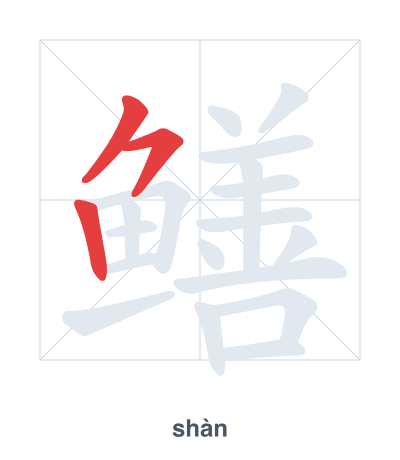
Open Hanzi Writer to see the animated stroke order and practice writing 鳝 with real-time feedback.
The character 鳝 (shàn) is written with 20 strokes. Follow the standard Chinese stroke order: top to bottom, left to right, outside before inside. The radical 鱼 is one of its key components.
Practice the correct stroke order with the Hanzi Writer app to see animated stroke-by-stroke guidance with real-time feedback.
鳝 means eel.
This character is a phono-semantic compound: the radical 鱼 (fish) indicates it is a type of fish, while 善 (shàn) provides the pronunciation. Eels are elongated, snake-like fish often found in fresh or saltwater.
💡 Memory Tip: Imagine a fish (鱼) that is so 'good' (善) at slithering through mud that it becomes an eel.
鳝鱼长得像蛇。
shàn yú zhǎng dé xiàng shé
Eels look like snakes.
田里有很多黄鳝。
tián lǐ yǒu hěn duō huáng shàn
There are many swamp eels in the field.
这里的鳝鱼面很好吃。
zhè lǐ de shàn yú miàn hěn hǎo chī
The eel noodles here are very delicious.
Open Hanzi Writer to see the animated stroke order and practice writing 鳝 with real-time feedback.
✨ Animated stroke order · Handwriting recognition · HSK-graded practice · Free to use
鳝 is composed of the radical 鱼 (fish) on the left and the phonetic component 善 (shàn, meaning "good") on the right. The radical tells you this character relates to a type of fish or aquatic animal, while the right side gives a clue to its pronunciation. Together, they form the character for "eel."