楸 (qiū) means "catalpa tree" in Chinese. It has 13 strokes with the radical 木.
Rated 4.2/5 in difficulty (advanced).
Appears in 3+ common words including 楸树 (qiū shù), 楸木 (qiū mù), 楸子 (qiū zi).
Due to its 13 strokes, Hanzi Writer's error detection shows 楸 requires focused practice — most learners need 10+ attempts for consistent accuracy.
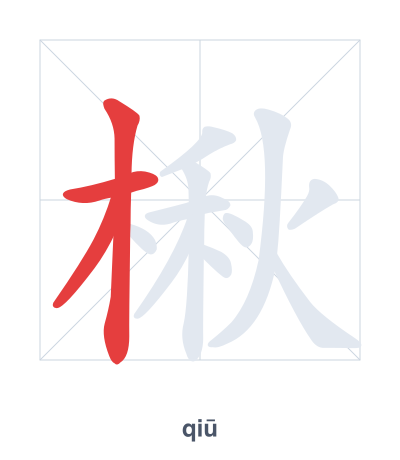
Open Hanzi Writer to see the animated stroke order and practice writing 楸 with real-time feedback.
The character 楸 (qiū) is written with 13 strokes. Follow the standard Chinese stroke order: top to bottom, left to right, outside before inside. The radical 木 is one of its key components.
Practice the correct stroke order with the Hanzi Writer app to see animated stroke-by-stroke guidance with real-time feedback.
楸 means catalpa tree.
This character is a phono-semantic compound. The radical 木 (tree) signals it is a type of tree, while the right component 秋 (autumn, qiū) provides the pronunciation and may allude to the catalpa's vibrant autumn foliage.
💡 Memory Tip: Picture a catalpa tree (木) glowing with golden leaves in autumn (秋), its name echoing the season.
院子里有一棵楸树。
yuàn zi lǐ yǒu yī kē qiū shù
There is a catalpa tree in the yard.
这张桌子是楸木做的。
zhè zhāng zhuō zi shì qiū mù zuò de
This table is made of catalpa wood.
楸子可以用来做药。
qiū zi kě yǐ yòng lái zuò yào
Catalpa seeds can be used to make medicine.
Open Hanzi Writer to see the animated stroke order and practice writing 楸 with real-time feedback.
✨ Animated stroke order · Handwriting recognition · HSK-graded practice · Free to use
楸 is composed of the radical 木 (tree) on the left and 秋 (autumn) on the right. The radical indicates it is a type of tree, while 秋 hints at its pronunciation (qiū) and also connects to the tree's seasonal traits, as catalpa trees often show notable autumn foliage.