樯 (qiáng) means "mast" in Chinese. It has 15 strokes with the radical 木.
Rated 4.2/5 in difficulty (advanced).
Appears in 3+ common words including 帆樯 (fān qiáng), 樯橹 (qiáng lǔ), 樯头 (qiáng tóu).
Due to its 15 strokes, Hanzi Writer's error detection shows 樯 requires focused practice — most learners need 10+ attempts for consistent accuracy.
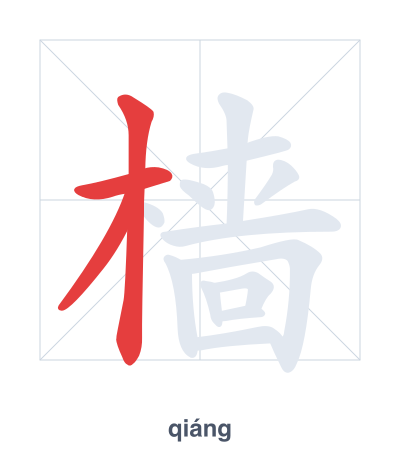
Open Hanzi Writer to see the animated stroke order and practice writing 樯 with real-time feedback.
The character 樯 (qiáng) is written with 15 strokes. Follow the standard Chinese stroke order: top to bottom, left to right, outside before inside. The radical 木 is one of its key components.
Practice the correct stroke order with the Hanzi Writer app to see animated stroke-by-stroke guidance with real-time feedback.
樯 means mast.
The character 樯 is a phono-semantic compound: the radical 木 (wood) indicates the material, and 墙 (qiáng, meaning 'wall') provides the pronunciation. A mast is a tall wooden pole rising from a ship's deck, like a vertical wall of wood.
💡 Memory Tip: Picture a ship's mast made of wood (木) so tall it looks like a wall (墙) reaching into the sky.
船上有高高的帆樯。
chuán shàng yǒu gāo gāo de fān qiáng
The boat has tall masts and sails.
樯橹在水中划动。
qiáng lǔ zài shuǐ zhōng huà dòng
The masts and oars are moving in the water.
鸟儿停在樯头。
niǎo ér tíng zài qiáng tóu
The bird perched on the top of the mast.
Open Hanzi Writer to see the animated stroke order and practice writing 樯 with real-time feedback.
✨ Animated stroke order · Handwriting recognition · HSK-graded practice · Free to use
樯 is made of the radical 木 (wood/tree) on the left, which hints that the character relates to wood or a wooden object. The right part is 啬 (sè), which originally meant a granary but here mainly indicates pronunciation — so the character means a wooden mast on a boat.