琦 (qí) means "Fine jade; admirable" in Chinese. It has 12 strokes with the radical 王.
Rated 4.2/5 in difficulty (advanced).
Appears in 3+ common words including 琦丽 (qí lì), 瑰琦 (guī qí), 琦琦 (qí qí).
Due to its 12 strokes, Hanzi Writer's error detection shows 琦 requires focused practice — most learners need 10+ attempts for consistent accuracy.
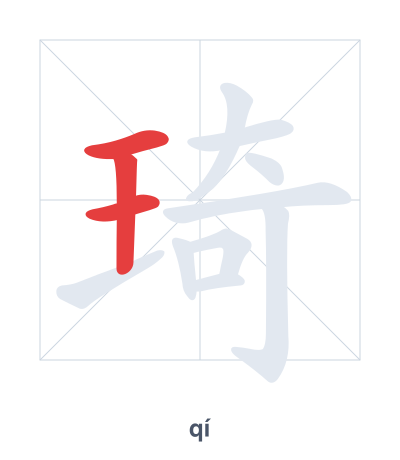
Open Hanzi Writer to see the animated stroke order and practice writing 琦 with real-time feedback.
The character 琦 (qí) is written with 12 strokes. Follow the standard Chinese stroke order: top to bottom, left to right, outside before inside. The radical 王 is one of its key components.
Practice the correct stroke order with the Hanzi Writer app to see animated stroke-by-stroke guidance with real-time feedback.
琦 means Fine jade; admirable.
琦 combines the jade radical 王 (yù) with 奇 (qí, 'strange' or 'unusual'), suggesting a piece of jade that is remarkably rare or excellent, hence 'fine jade' or 'admirable.'
💡 Memory Tip: Picture a king (王) admiring a strangely-shaped (奇) piece of jade that glows with extraordinary beauty.
这里的风景很琦丽。
zhè lǐ de fēng jǐng hěn qí lì
The scenery here is very magnificent.
这块石头非常瑰琦。
zhè kuài shí tou fēi cháng guī qí
This stone is magnificent.
琦琦是她的外号。
qí qí shì tā de wài hào
Qiqi is her nickname.
Open Hanzi Writer to see the animated stroke order and practice writing 琦 with real-time feedback.
✨ Animated stroke order · Handwriting recognition · HSK-graded practice · Free to use
琦 is composed of the radical 王 (jade) on the left and the phonetic component 奇 (qí) on the right. The 王 radical connects the character to jade or precious stones, while 奇 adds the pronunciation and a hint of 'extraordinary' or 'remarkable'. Together, they form the idea of 'fine jade' or something admirable.