溥 (pǔ) means "vast; extensive; universal" in Chinese. It has 13 strokes with the radical 氵.
Rated 4.2/5 in difficulty (advanced).
Appears in 3+ common words including 溥博 (pǔ bó), 溥天 (pǔ tiān), 溥原 (pǔ yuán).
Due to its 13 strokes, Hanzi Writer's error detection shows 溥 requires focused practice — most learners need 10+ attempts for consistent accuracy.
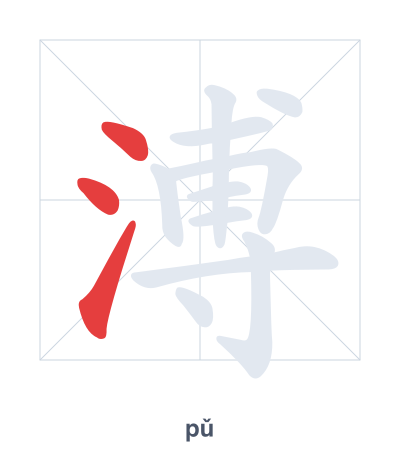
Open Hanzi Writer to see the animated stroke order and practice writing 溥 with real-time feedback.
The character 溥 (pǔ) is written with 13 strokes. Follow the standard Chinese stroke order: top to bottom, left to right, outside before inside. The radical 氵 is one of its key components.
Practice the correct stroke order with the Hanzi Writer app to see animated stroke-by-stroke guidance with real-time feedback.
溥 means vast; extensive; universal.
溥 combines the water radical (氵) with 尃 (fū, 'to spread'), suggesting water spreading out over a vast area. This evokes the image of a flood or wide river, lending the character its meanings of 'vast' and 'extensive'.
💡 Memory Tip: Imagine a flood of water (氵) spreading out (尃) across the entire landscape, covering everything in a vast, universal sheet.
他的学问溥博。
tā de xué wèn pǔ bó
His knowledge is vast and broad.
溥天之下。
pǔ tiān zhī xià
Under the whole heaven; all over the world.
溥原是一个地名。
pǔ yuán shì yí gè dì míng
Puyuan is a place name.
Open Hanzi Writer to see the animated stroke order and practice writing 溥 with real-time feedback.
✨ Animated stroke order · Handwriting recognition · HSK-graded practice · Free to use
The left side is the radical 氵 (water), and the right side is 尃 (fū), which gives the sound. Water spreading out suggests the idea of vastness or extensiveness, matching the character's meaning of 'vast' or 'universal'.