莆 (pú) means "Putian (place name prefix)" in Chinese. It has 10 strokes with the radical 艹.
Rated 4.2/5 in difficulty (advanced).
Appears in 3+ common words including 莆田 (pú tián), 莆仙 (pú xiān), 莆草 (pú cǎo).
Due to its 10 strokes, Hanzi Writer's error detection shows 莆 requires focused practice — most learners need 10+ attempts for consistent accuracy.
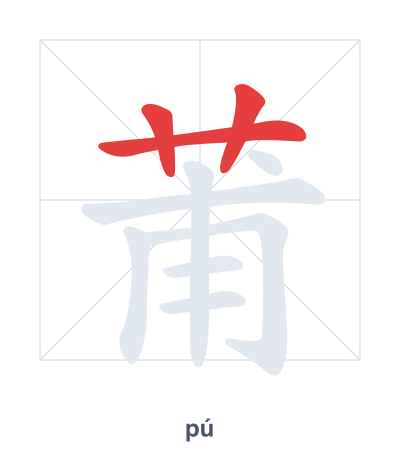
Open Hanzi Writer to see the animated stroke order and practice writing 莆 with real-time feedback.
The character 莆 (pú) is written with 10 strokes. Follow the standard Chinese stroke order: top to bottom, left to right, outside before inside. The radical 艹 is one of its key components.
Practice the correct stroke order with the Hanzi Writer app to see animated stroke-by-stroke guidance with real-time feedback.
莆 means Putian (place name prefix).
The character 莆 is a compound with the grass radical 艹 indicating a plant, and 甫 (fǔ) providing the pronunciation. It originally referred to a type of herb or weed, but is now primarily used in the place name Putian (莆田) in Fujian province. The phonetic component 甫 itself means 'begin' or 'father,' but here it serves only to suggest the sound pú.
💡 Memory Tip: Imagine a field of grass (艹) sprouting from a 'first' marker (甫) at the entrance of Putian city.
他出生在福建莆田。
tā chū shēng zài fú jiàn pú tián
He was born in Putian, Fujian.
莆仙戏很有地方特色。
pú xiān xì hěn yǒu dì fāng tè sè
Puxian Opera has strong local characteristics.
这种莆草可以用来编织。
zhè zhǒng pú cǎo kě yǐ yòng lái biān zhī
This type of bulrush can be used for weaving.
Open Hanzi Writer to see the animated stroke order and practice writing 莆 with real-time feedback.
✨ Animated stroke order · Handwriting recognition · HSK-graded practice · Free to use
The character 莆 is composed of the grass radical 艹 on top and the phonetic component 甫 (fǔ) below. The grass radical indicates that the character relates to plants, while 莆 originally referred to a type of grass (莆草) used for weaving mats. Modern usage shifted to a place name prefix for Putian, but the plant connection remains in the radical.