钷 (pǒ) means "promethium" in Chinese. It has 10 strokes with the radical 钅.
Rated 4.2/5 in difficulty (advanced).
Appears in 3+ common words including 钷元素 (pǒ yuán sù), 钷盐 (pǒ yán), 钷化合物 (pǒ huà hé wù).
Due to its 10 strokes, Hanzi Writer's error detection shows 钷 requires focused practice — most learners need 10+ attempts for consistent accuracy.
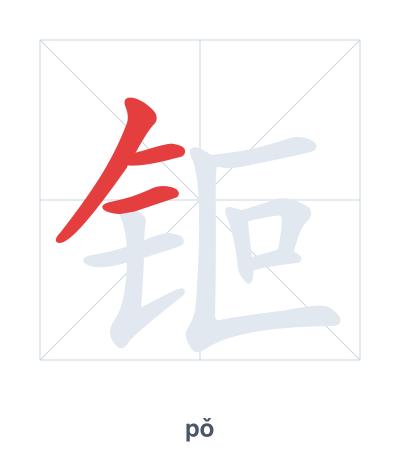
Open Hanzi Writer to see the animated stroke order and practice writing 钷 with real-time feedback.
The character 钷 (pǒ) is written with 10 strokes. Follow the standard Chinese stroke order: top to bottom, left to right, outside before inside. The radical 钅 is one of its key components.
Practice the correct stroke order with the Hanzi Writer app to see animated stroke-by-stroke guidance with real-time feedback.
钷 means promethium.
钷 is a phono-semantic compound created for the element promethium. The radical 钅 (metal) indicates it is a metallic element, while the phonetic component 叵 (pǒ, meaning 'cannot' or 'imperative') approximates the sound of 'prom' from Prometheus, the Titan who stole fire. The character visually combines a metal radical with a box-like shape containing a mouth, hinting at the element's synthetic nature (cannot be found readily in nature).
💡 Memory Tip: Imagine a metal box (钅) with a mouth inside (叵) that says 'I cannot tell you where promethium is hidden,' emphasizing its rare, man-made origin.
钷是一种放射性元素。
pǒ shì yī zhǒng fàng shè xìng yuán sù
Promethium is a radioactive element.
实验室里有少量的钷盐。
shí yàn shì lǐ yǒu shǎo liàng de pǒ yán
There is a small amount of promethium salt in the laboratory.
科学家在研究钷化合物。
kē xué jiā zài yán jiū pǒ huà hé wù
Scientists are studying promethium compounds.
Open Hanzi Writer to see the animated stroke order and practice writing 钷 with real-time feedback.
✨ Animated stroke order · Handwriting recognition · HSK-graded practice · Free to use
钷 is composed of the radical 钅 (jīn, meaning metal) on the left and the phonetic component 叵 (pǒ) on the right. The metal radical indicates that this character refers to a metallic element, while the right side gives a clue to its pronunciation. This is typical for Chinese chemical element characters, where the radical shows the category and the other part suggests the sound.