颦 (pín) means "To frown" in Chinese. It has 21 strokes with the radical 步.
Rated 3.5/5 in difficulty (challenging).
Appears in 3+ common words including 一颦一笑 (yī pín yī xiào), 颦蹙 (pín cù), 效颦 (xiào pín).
Due to its 21 strokes, Hanzi Writer's error detection shows 颦 requires focused practice — most learners need 10+ attempts for consistent accuracy.
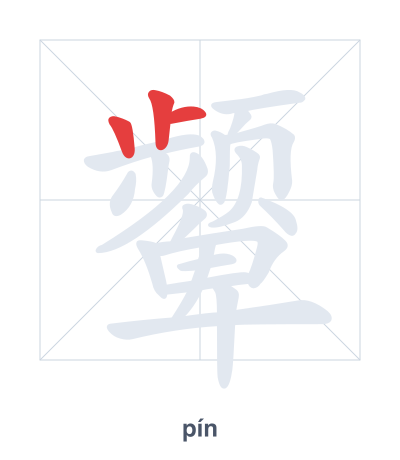
Open Hanzi Writer to see the animated stroke order and practice writing 颦 with real-time feedback.
The character 颦 (pín) is written with 21 strokes. Follow the standard Chinese stroke order: top to bottom, left to right, outside before inside. The radical 步 is one of its key components.
Practice the correct stroke order with the Hanzi Writer app to see animated stroke-by-stroke guidance with real-time feedback.
颦 means To frown.
| Character | 颦 |
| Pinyin | pín (pin) |
| Meaning | To frown |
| Strokes | 21 |
| Radical | 步 |
| Difficulty | 3.5/5 |
颦 combines 步 (step) and 页 (head/face). The furrowed brows of a frown create wrinkles on the forehead that resemble steps, visually linking the two components to the meaning 'to frown.'
💡 Memory Tip: Step (步) on a thorn and frown as your head (页) throbs in pain.
她的一颦一笑很美。
tā de yī pín yī xiào hěn měi
Her every expression is beautiful.
她眉头颦蹙。
tā méi tóu pín cù
She is frowning.
不要盲目效颦。
bú yào máng mù xiào pín
Don't blindly imitate others.
Open Hanzi Writer to see the animated stroke order and practice writing 颦 with real-time feedback.
✨ Animated stroke order · Handwriting recognition · HSK-graded practice · Free to use
The character 颦 is composed of 步 (step) on top and 频 (frequency) on the bottom. The bottom part 频 itself contains 步 and 页 (head), so the character has two 'step' radicals. This repeated stepping might suggest the repetitive motion of knitting one's brows, which is the action of frowning.