砒 (pī) means "arsenic" in Chinese. It has 9 strokes with the radical 石.
Rated 4/5 in difficulty (challenging).
Appears in 3+ common words including 砒霜 (pī shuāng), 砒毒 (pī dú), 砒石 (pī shí).
Due to its 9 strokes, Hanzi Writer's error detection shows 砒 requires focused practice — most learners need 10+ attempts for consistent accuracy.
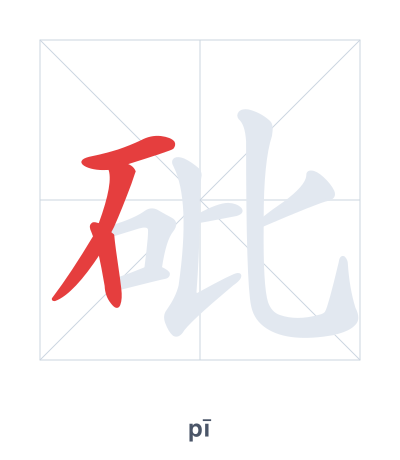
Open Hanzi Writer to see the animated stroke order and practice writing 砒 with real-time feedback.
The character 砒 (pī) is written with 9 strokes. Follow the standard Chinese stroke order: top to bottom, left to right, outside before inside. The radical 石 is one of its key components.
Practice the correct stroke order with the Hanzi Writer app to see animated stroke-by-stroke guidance with real-time feedback.
砒 means arsenic.
砒 is a phono-semantic compound: the radical 石 indicates a stone or mineral, while 比 (bǐ) provides the pronunciation. It refers to arsenic, a highly toxic mineral historically used in poisons and pesticides.
💡 Memory Tip: Picture a stone (石) so toxic that two people (比) who touch it instantly turn green and faint.
这种药里含有砒霜。
zhè zhǒng yào lǐ hán yǒu pī shuāng
This medicine contains arsenic.
这种砒毒非常厉害。
zhè zhǒng pī dú fēi cháng lì hài
This arsenic poison is very potent.
他在实验室观察砒石。
tā zài shí yàn shì guān chá pī shí
He is observing arsenic stone in the laboratory.
Open Hanzi Writer to see the animated stroke order and practice writing 砒 with real-time feedback.
✨ Animated stroke order · Handwriting recognition · HSK-graded practice · Free to use
砒 is composed of the radical 石 (stone) on the left and the phonetic component 比 (bǐ) on the right. The radical indicates that arsenic is a type of mineral or rock, while 比 provides a clue to the pronunciation (pī). This follows the common pattern of a semantic-phonetic compound in Chinese characters.