坯 (pī) means "unbaked brick; base; blank" in Chinese. It has 8 strokes with the radical 土.
Rated 3.7/5 in difficulty (challenging).
Appears in 3+ common words including 坯布 (pī bù), 砖坯 (zhuān pī), 坯子 (pī zi).
Due to its 8 strokes, Hanzi Writer's error detection shows 坯 requires focused practice — most learners need 10+ attempts for consistent accuracy.
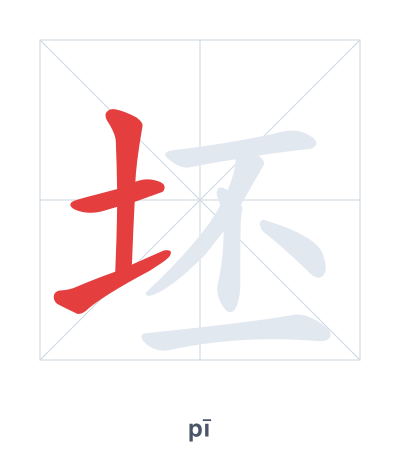
Open Hanzi Writer to see the animated stroke order and practice writing 坯 with real-time feedback.
The character 坯 (pī) is written with 8 strokes. Follow the standard Chinese stroke order: top to bottom, left to right, outside before inside. The radical 土 is one of its key components.
Practice the correct stroke order with the Hanzi Writer app to see animated stroke-by-stroke guidance with real-time feedback.
坯 means unbaked brick; base; blank.
坯 is a compound character combining the radical 土 (earth/clay) with 丕 (pī, serving as a phonetic and also suggesting an unfinished state). Together, they depict a lump of clay that has been shaped but not yet fired, hence 'unbaked brick' or 'base form.'
💡 Memory Tip: Imagine a pile of earth (土) under a big sign saying 'Not Yet Fired' (like 丕, which resembles an unfinished 不), reminding you this is just a raw brick blank.
这种坯布质量很好。
zhè zhǒng pī bù zhì liàng hěn hǎo
The quality of this grey cloth is very good.
工人们在搬运砖坯。
gōng rén men zài bān yùn zhuān pī
Workers are carrying unfired bricks.
他是个学画画的好坯子。
tā shì gè xué huà huà de hǎo pī zi
He is a natural talent for painting.
Open Hanzi Writer to see the animated stroke order and practice writing 坯 with real-time feedback.
✨ Animated stroke order · Handwriting recognition · HSK-graded practice · Free to use
The left component is 土 (tǔ, earth/soil), which relates to clay used for making bricks. The right component is 丕 (pī), which provides the pronunciation. Together, they form a character meaning 'unbaked brick' or 'base material' made from earth.