砰 (pēng) means "bang / thud" in Chinese. It has 10 strokes with the radical 石.
Rated 4.2/5 in difficulty (advanced).
Appears in 3+ common words including 砰砰 (pēng pēng), 砰的一声 (pēng de yī shēng), 砰然 (pēng rán).
Due to its 10 strokes, Hanzi Writer's error detection shows 砰 requires focused practice — most learners need 10+ attempts for consistent accuracy.
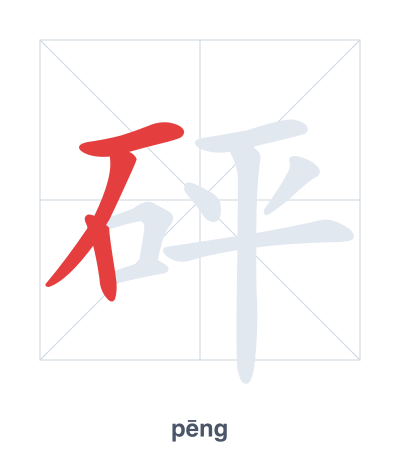
Open Hanzi Writer to see the animated stroke order and practice writing 砰 with real-time feedback.
The character 砰 (pēng) is written with 10 strokes. Follow the standard Chinese stroke order: top to bottom, left to right, outside before inside. The radical 石 is one of its key components.
Practice the correct stroke order with the Hanzi Writer app to see animated stroke-by-stroke guidance with real-time feedback.
砰 means bang / thud.
砰 combines the radical 石 (stone) with 平 (flat/level) as a phonetic component, suggesting the sound of a stone striking a flat surface. The meaning 'bang/thud' echoes this impact, with pronunciation mirroring the noise.
💡 Memory Tip: Picture a stone (石) slamming onto a perfectly flat (平) steel plate, producing a deafening BANG.
我的心砰砰跳。
wǒ de xīn pēng pēng tiào
My heart is beating fast.
门砰的一声关了。
mén pēng de yī shēng guān le
The door slammed shut.
他砰然心动了。
tā pēng rán xīn dòng le
His heart skipped a beat.
Open Hanzi Writer to see the animated stroke order and practice writing 砰 with real-time feedback.
✨ Animated stroke order · Handwriting recognition · HSK-graded practice · Free to use
砰 is made of the radical 石 (stone) on the left and 平 (flat/level) on the right. The stone radical hints at sounds made by hard objects, while 平 gives the pronunciation pēng. Together they form an onomatopoeic character for a loud bang or thud.