辔 (pèi) means "Reins." in Chinese. It has 13 strokes with the radical 车.
Rated 4.2/5 in difficulty (advanced).
Appears in 3+ common words including 辔头 (pèi tóu), 鞍辔 (ān pèi), 按辔 (àn pèi).
Due to its 13 strokes, Hanzi Writer's error detection shows 辔 requires focused practice — most learners need 10+ attempts for consistent accuracy.
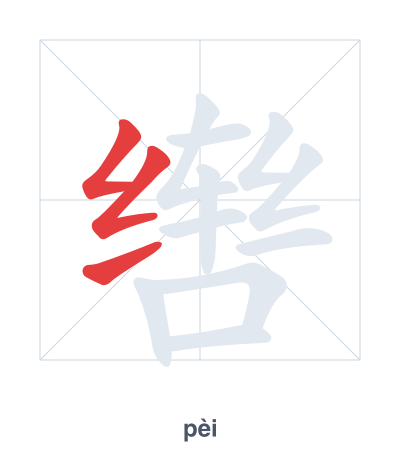
Open Hanzi Writer to see the animated stroke order and practice writing 辔 with real-time feedback.
The character 辔 (pèi) is written with 13 strokes. Follow the standard Chinese stroke order: top to bottom, left to right, outside before inside. The radical 车 is one of its key components.
Practice the correct stroke order with the Hanzi Writer app to see animated stroke-by-stroke guidance with real-time feedback.
辔 means Reins..
辔 is a compound character. The left part, 车 (chariot), indicates the context of driving. The right part was originally a pictograph of a hand holding a bundle of straps, which together with the chariot radical represents the reins used to control the horse.
💡 Memory Tip: Picture a chariot (车) with a curved rein (the right part, 㐭) looped around its driver's hand, with a dot as the knot at the end.
牵住马的辔头。
qiān zhù mǎ de pèi tóu
Hold the horse's bridle.
鞍辔非常整齐。
ān pèi fēi cháng zhěng qí
The saddle and bridle are very neat.
他按辔慢慢走。
tā àn pèi màn màn zǒu
He held the reins and walked slowly.
Open Hanzi Writer to see the animated stroke order and practice writing 辔 with real-time feedback.
✨ Animated stroke order · Handwriting recognition · HSK-graded practice · Free to use
辔 is composed of the radical 车 (vehicle) on the left, and the phonetic component 䇂 (a variant of 辛) on the right. The 车 radical hints at its connection to horse-drawn vehicles, as reins control a horse pulling a cart. The overall character means "reins" or the straps used to guide a horse.