帔 (pèi) means "A cape or mantle (ancient garment)." in Chinese. It has 8 strokes with the radical 巾.
Rated 3.7/5 in difficulty (challenging).
Appears in 3+ common words including 帔子 (pèi zi), 霞帔 (xiá pèi), 披帔 (pī pèi).
Due to its 8 strokes, Hanzi Writer's error detection shows 帔 requires focused practice — most learners need 10+ attempts for consistent accuracy.
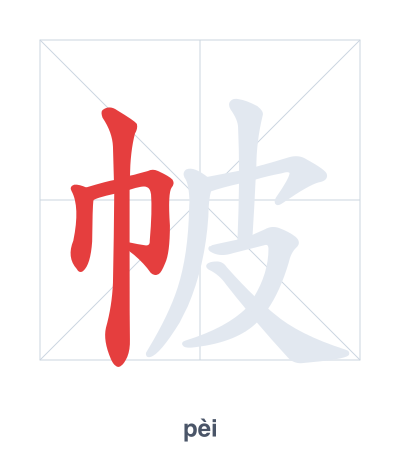
Open Hanzi Writer to see the animated stroke order and practice writing 帔 with real-time feedback.
The character 帔 (pèi) is written with 8 strokes. Follow the standard Chinese stroke order: top to bottom, left to right, outside before inside. The radical 巾 is one of its key components.
Practice the correct stroke order with the Hanzi Writer app to see animated stroke-by-stroke guidance with real-time feedback.
帔 means A cape or mantle (ancient garment)..
帔 is a phono-semantic compound. The radical 巾 (cloth) indicates it is a garment, while the phonetic component 皮 (pí, meaning 'skin' or 'hide') hints at the sound pèi and also suggests a cape worn over the skin like a second layer.
💡 Memory Tip: Picture a cape made of animal skin (皮) draped over a cloth (巾) hanger — it's the ancient cloak you slip over your shoulders.
她身上披着帔子。
tā shēn shàng pī zhe pèi zi
She is wearing a shawl over her shoulders.
霞帔非常漂亮。
xiá pèi fēi cháng piào liàng
The embroidered cape is very beautiful.
这种披帔很轻。
zhè zhǒng pī pèi hěn qīng
This cape is very light.
Open Hanzi Writer to see the animated stroke order and practice writing 帔 with real-time feedback.
✨ Animated stroke order · Handwriting recognition · HSK-graded practice · Free to use
The character 帔 is composed of the radical 巾 (cloth) on the left and the phonetic component 皮 (pí) on the right. The 巾 radical points to clothing, while 皮 hints at the pronunciation pèi and also suggests the idea of a covering, like a cape made of skin.