钠 (nà) means "Sodium" in Chinese. It has 9 strokes with the radical 钅.
Rated 4/5 in difficulty (challenging).
Appears in 3+ common words including 钠盐 (nà yán), 氯化钠 (lǜ huà nà), 钠灯 (nà dēng).
Due to its 9 strokes, Hanzi Writer's error detection shows 钠 requires focused practice — most learners need 10+ attempts for consistent accuracy.
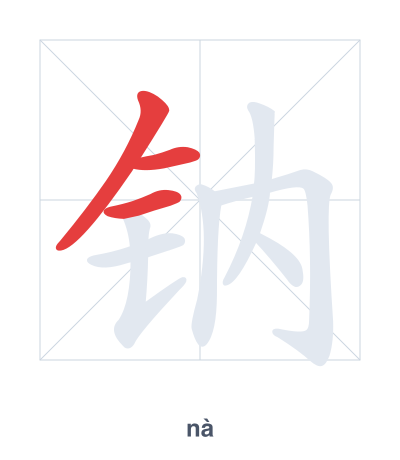
Open Hanzi Writer to see the animated stroke order and practice writing 钠 with real-time feedback.
The character 钠 (nà) is written with 9 strokes. Follow the standard Chinese stroke order: top to bottom, left to right, outside before inside. The radical 钅 is one of its key components.
Practice the correct stroke order with the Hanzi Writer app to see animated stroke-by-stroke guidance with real-time feedback.
钠 means Sodium.
钠 is a compound character combining the radical 钅 (metal) with 内 (inside, phonetic hint for nà), indicating a metallic element. This reflects sodium's classification as a soft, silvery metal.
💡 Memory Tip: Picture a metal (钅) box with a chunk of sodium inside (内) that violently explodes when water touches it.
这种食物含钠盐多。
zhè zhǒng shí wù hán nà yán duō
This food is high in sodium.
食盐就是氯化钠。
shí yán jiù shì lǜ huà nà
Table salt is sodium chloride.
路边装了钠灯。
lù biān zhuāng le nà dēng
Sodium lamps are installed along the roadside.
Open Hanzi Writer to see the animated stroke order and practice writing 钠 with real-time feedback.
✨ Animated stroke order · Handwriting recognition · HSK-graded practice · Free to use
钠 has the radical 钅 (metal/gold) on the left, showing it is a metal element. The right part 内 (nèi, inside) gives a pronunciation hint. Together they form the character for sodium, a soft alkali metal.