鍪 (móu) means "helmet / cauldron" in Chinese. It has 17 strokes with the radical 金.
Rated 4.2/5 in difficulty (advanced).
Appears in 3+ common words including 兜鍪 (dōu móu), 鍪甲 (móu jiǎ), 鍪子 (móu zi).
Due to its 17 strokes, Hanzi Writer's error detection shows 鍪 requires focused practice — most learners need 10+ attempts for consistent accuracy.
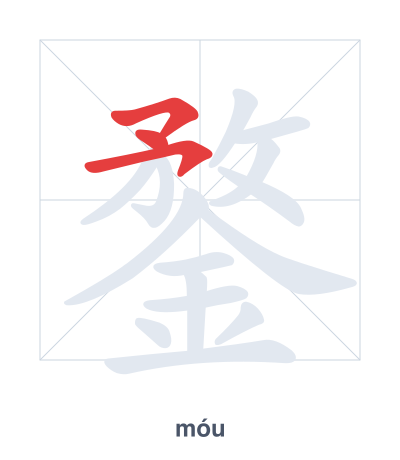
Open Hanzi Writer to see the animated stroke order and practice writing 鍪 with real-time feedback.
The character 鍪 (móu) is written with 17 strokes. Follow the standard Chinese stroke order: top to bottom, left to right, outside before inside. The radical 金 is one of its key components.
Practice the correct stroke order with the Hanzi Writer app to see animated stroke-by-stroke guidance with real-time feedback.
鍪 means helmet / cauldron.
| Character | 鍪 |
| Pinyin | móu (mou) |
| Meaning | helmet / cauldron |
| Strokes | 17 |
| Radical | 金 |
| Difficulty | 4.2/5 |
鍪 is a phono-semantic compound: the radical 金 (metal) indicates it is made of metal, while the phonetic component 敄 (wù, combining 矛 'spear' and 攵 'action') provides the sound. Ancient helmets and cauldrons were both crafted from metal, linking the character to these meanings.
💡 Memory Tip: Picture a metal helmet (金) being hammered by a spear (矛) and a hand (攵) to reshape it into a cauldron for cooking.
将军戴上了兜鍪。
jiāng jūn dài shàng le dōu móu
The general put on his helmet.
战士穿着鍪甲。
zhàn shì chuān zhe móu jiǎ
The soldier is wearing a helmet and armor.
这是一个铁鍪子。
zhè shì yí gè tiě móu zi
This is an iron helmet.
Open Hanzi Writer to see the animated stroke order and practice writing 鍪 with real-time feedback.
✨ Animated stroke order · Handwriting recognition · HSK-graded practice · Free to use
鍪 is composed of two parts: the top part 敄 (a phonetic component) and the bottom part 金 (gold/metal). Since 金 indicates metal, and helmets and cauldrons were historically made of metal, the character's meaning relates to metal-based objects like helmets or cooking pots.