侔 (móu) means "equal; similar" in Chinese. It has 8 strokes with the radical 亻.
Rated 3.4/5 in difficulty (challenging).
Appears in 3+ common words including 相侔 (xiāng móu), 齐侔 (qí móu), 侔色 (móu sè).
Due to its 8 strokes, Hanzi Writer's error detection shows 侔 requires focused practice — most learners need 10+ attempts for consistent accuracy.
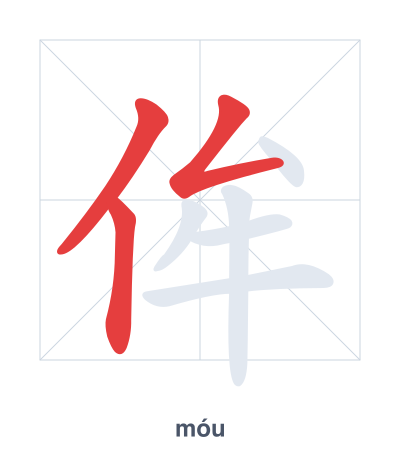
Open Hanzi Writer to see the animated stroke order and practice writing 侔 with real-time feedback.
The character 侔 (móu) is written with 8 strokes. Follow the standard Chinese stroke order: top to bottom, left to right, outside before inside. The radical 亻 is one of its key components.
Practice the correct stroke order with the Hanzi Writer app to see animated stroke-by-stroke guidance with real-time feedback.
侔 means equal; similar.
侔 is a phono-semantic compound: the left side 亻 (person) indicates that the word relates to people, while the right side 牟 (móu, originally depicting a cow's lowing mouth) provides the sound. Together, they suggest two persons being alike or matching—hence the meaning 'equal' or 'similar.'
💡 Memory Tip: Picture a person (亻) standing next to a cow (牟), and they are exactly equal in height, forming a perfect pair.
两人的能力相侔。
liǎng rén de néng lì xiāng móu
Their abilities are equal.
他的名声与你齐侔。
tā de míng shēng yǔ nǐ qí móu
His reputation is equal to yours.
这幅画侔色自然。
zhè fú huà móu sè zì rán
The colors in this painting look very natural.
Open Hanzi Writer to see the animated stroke order and practice writing 侔 with real-time feedback.
✨ Animated stroke order · Handwriting recognition · HSK-graded practice · Free to use
The left component 亻 is the radical for 'person', indicating that the character relates to people. The right component 牟 provides the pronunciation móu and also suggests the idea of 'seeking' or 'matching', so together the character means 'equal' or 'similar' between persons or things.