眽 (mò) means "to gaze" in Chinese. It has 11 strokes with the radical 目.
Rated 4.2/5 in difficulty (advanced).
Appears in 3+ common words including 眽眽 (mò mò), 温情眽眽 (wēn qíng mò mò), 眽眽含情 (mò mò hán qíng).
Due to its 11 strokes, Hanzi Writer's error detection shows 眽 requires focused practice — most learners need 10+ attempts for consistent accuracy.
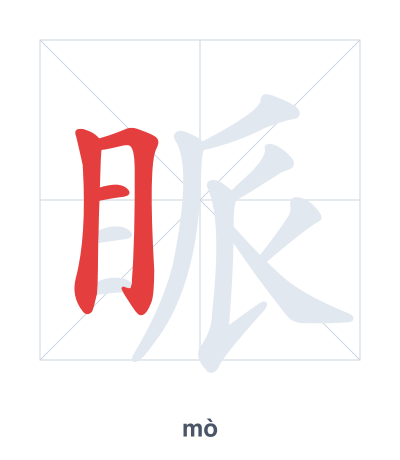
Open Hanzi Writer to see the animated stroke order and practice writing 眽 with real-time feedback.
The character 眽 (mò) is written with 11 strokes. Follow the standard Chinese stroke order: top to bottom, left to right, outside before inside. The radical 目 is one of its key components.
Practice the correct stroke order with the Hanzi Writer app to see animated stroke-by-stroke guidance with real-time feedback.
眽 means to gaze.
This character combines the eye radical 目 (mù) with a component 氺 (shuǐ), a variant of 'water'. The image is of eyes fixed on flowing water, evoking a steady, focused gaze.
💡 Memory Tip: Imagine your eyes (目) locked onto a stream (氺) so deeply that you see each ripple—that's a gaze (眽).
他们两人眽眽相对。
tā men liǎng rén mò mò xiāng duì
The two of them gazed at each other affectionately.
他的目光温情眽眽。
tā de mù guāng wēn qíng mò mò
His gaze is full of tender affection.
她眽眽含情地看着他。
tā mò mò hán qíng dì kàn zhe tā
She looked at him with deep affection.
Open Hanzi Writer to see the animated stroke order and practice writing 眽 with real-time feedback.
✨ Animated stroke order · Handwriting recognition · HSK-graded practice · Free to use
眽 is composed of the radical 目 (eye) on the left, which shows the meaning is related to vision or looking. The right part is a phonetic component that gives the pronunciation 'mò'. Together they create the idea of using one's eyes to gaze.