泯 (mǐn) means "to vanish; to die out" in Chinese. It has 8 strokes with the radical 氵.
Rated 3.7/5 in difficulty (challenging).
Appears in 3+ common words including 泯灭 (mǐn miè), 未泯 (wèi mǐn), 泯除 (mǐn chú).
Due to its 8 strokes, Hanzi Writer's error detection shows 泯 requires focused practice — most learners need 10+ attempts for consistent accuracy.
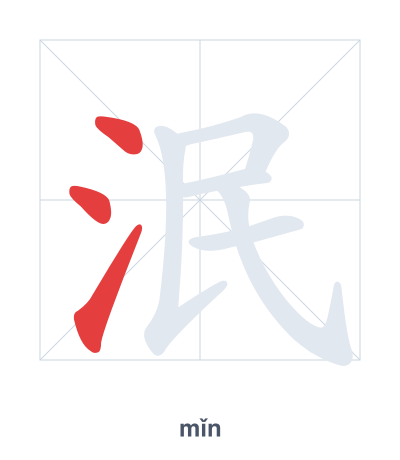
Open Hanzi Writer to see the animated stroke order and practice writing 泯 with real-time feedback.
The character 泯 (mǐn) is written with 8 strokes. Follow the standard Chinese stroke order: top to bottom, left to right, outside before inside. The radical 氵 is one of its key components.
Practice the correct stroke order with the Hanzi Writer app to see animated stroke-by-stroke guidance with real-time feedback.
泯 means to vanish; to die out.
This is a phono-semantic compound. The radical 氵 (water) suggests flowing away or eroding, while 民 (mǐn, 'people') provides the sound and adds the sense of 'common folk'—together implying people being swept away or disappearing like water.
💡 Memory Tip: Picture a flood (氵) washing away a crowd of people (民) until they vanish without a trace.
记忆不会泯灭。
jì yì bú huì mǐn miè
Memories will not fade away.
他的童心未泯。
tā de tóng xīn wèi mǐn
He still has a childlike heart.
恩怨已经泯除。
ēn yuàn yǐ jīng mǐn chú
Grudges have been settled.
Open Hanzi Writer to see the animated stroke order and practice writing 泯 with real-time feedback.
✨ Animated stroke order · Handwriting recognition · HSK-graded practice · Free to use
泯 combines the water radical 氵 (shuǐ) on the left with 民 (mín, people) on the right. The water component suggests flowing away or washing out, while 民 as a phonetic component gives the sound mǐn; together they imply something disappearing like water carrying away people or being extinguished.