铆 (mǎo) means "to rivet" in Chinese. It has 10 strokes with the radical 钅.
Rated 4.2/5 in difficulty (advanced).
Appears in 3+ common words including 铆钉 (mǎo dīng), 铆接 (mǎo jiē), 铆劲 (mǎo jìn).
Due to its 10 strokes, Hanzi Writer's error detection shows 铆 requires focused practice — most learners need 10+ attempts for consistent accuracy.
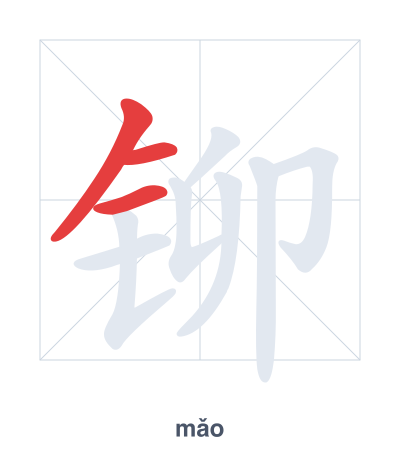
Open Hanzi Writer to see the animated stroke order and practice writing 铆 with real-time feedback.
The character 铆 (mǎo) is written with 10 strokes. Follow the standard Chinese stroke order: top to bottom, left to right, outside before inside. The radical 钅 is one of its key components.
Practice the correct stroke order with the Hanzi Writer app to see animated stroke-by-stroke guidance with real-time feedback.
铆 means to rivet.
铆 is a phono-semantic compound. The radical 钅 (metal) indicates the material, as rivets are metal fasteners. The component 卯 (mǎo) provides the pronunciation and also hints at the joining function, since 卯 originally depicted a mortise hole in woodworking, a fitting connection for riveting.
💡 Memory Tip: Imagine a metal rivet (钅) shaped like a cross (卯) being hammered into two metal plates to join them firmly.
这个包上有铆钉。
zhè ge bāo shàng yǒu mǎo dīng
There are rivets on this bag.
这里的零件需要铆接。
zhè lǐ de líng jiàn xū yào mǎo jiē
The parts here need to be riveted.
他铆劲往前跑。
tā mǎo jìn wǎng qián pǎo
He ran forward with all his might.
Open Hanzi Writer to see the animated stroke order and practice writing 铆 with real-time feedback.
✨ Animated stroke order · Handwriting recognition · HSK-graded practice · Free to use
铆 is composed of the radical 钅 (jīn, meaning metal) on the left and the component 卯 (mǎo) on the right. 卯 originally referred to a mortise (a hole in woodworking), so together they suggest "metal pin inserted into a hole," which is exactly what riveting does.