锚 (máo) means "Anchor" in Chinese. It has 13 strokes with the radical 钅.
Rated 4.2/5 in difficulty (advanced).
Appears in 3+ common words including 抛锚 (pāo máo), 船锚 (chuán máo), 锚地 (máo dì).
Due to its 13 strokes, Hanzi Writer's error detection shows 锚 requires focused practice — most learners need 10+ attempts for consistent accuracy.
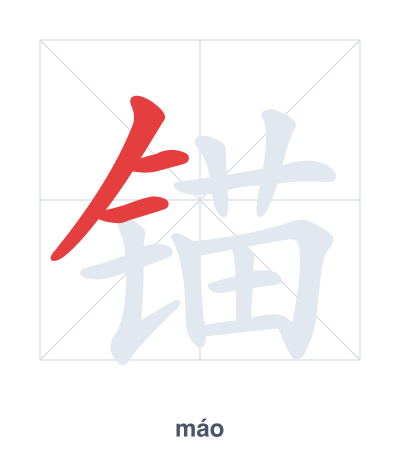
Open Hanzi Writer to see the animated stroke order and practice writing 锚 with real-time feedback.
The character 锚 (máo) is written with 13 strokes. Follow the standard Chinese stroke order: top to bottom, left to right, outside before inside. The radical 钅 is one of its key components.
Practice the correct stroke order with the Hanzi Writer app to see animated stroke-by-stroke guidance with real-time feedback.
锚 means Anchor.
锚 is a phono-semantic compound where 钅 (gold/metal) indicates the material of an anchor, and 苗 (miáo) contributes to the pronunciation. The character visually represents a metal device used to moor ships.
💡 Memory Tip: Picture a metal hook (钅) shaped like a tiny plant (苗) digging into the seabed to hold a boat steady.
汽车在路上抛锚了。
qì chē zài lù shàng pāo máo le
The car broke down on the road.
船锚掉进了水里。
chuán máo diào jìn le shuǐ lǐ
The anchor dropped into the water.
船停在锚地。
chuán tíng zài máo dì
The ship is at the anchorage.
Open Hanzi Writer to see the animated stroke order and practice writing 锚 with real-time feedback.
✨ Animated stroke order · Handwriting recognition · HSK-graded practice · Free to use
锚 is made of two parts: the left side 钅 (jīn, metal) and the right side 苗 (miáo, seedling). The metal radical shows that anchors are made of metal, while 苗 hints at the pronunciation máo and also suggests something that holds a boat in place like a plant rooted in the ground.