漭 (mǎng) means "vast (of water)" in Chinese. It has 13 strokes with the radical 氵.
Rated 4.2/5 in difficulty (advanced).
Appears in 3+ common words including 漭漭 (mǎng mǎng), 沧漭 (cāng mǎng), 漭沆 (mǎng hàng).
Due to its 13 strokes, Hanzi Writer's error detection shows 漭 requires focused practice — most learners need 10+ attempts for consistent accuracy.
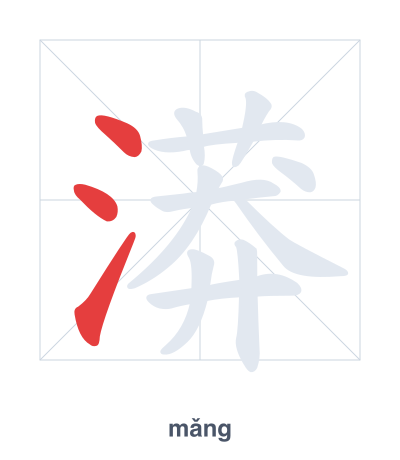
Open Hanzi Writer to see the animated stroke order and practice writing 漭 with real-time feedback.
The character 漭 (mǎng) is written with 13 strokes. Follow the standard Chinese stroke order: top to bottom, left to right, outside before inside. The radical 氵 is one of its key components.
Practice the correct stroke order with the Hanzi Writer app to see animated stroke-by-stroke guidance with real-time feedback.
漭 means vast (of water).
漭 combines the water radical 氵 with 莽 (mǎng, meaning 'thick grass' or 'wild'), suggesting a vast, watery expanse overgrown with vegetation, like a marshy floodplain.
💡 Memory Tip: Imagine a dog (犬) running through thick grass (艹) near an endless body of water (氵), overwhelmed by the vastness of 漭.
大海漭漭无边。
dà hǎi mǎng mǎng wú biān
The sea is vast and boundless.
景色十分沧漭。
jǐng sè shí fēn cāng mǎng
The scenery is vast and boundless.
这里的气势漭沆。
zhè lǐ de qì shì mǎng hàng
The momentum here is vast and expansive.
Open Hanzi Writer to see the animated stroke order and practice writing 漭 with real-time feedback.
✨ Animated stroke order · Handwriting recognition · HSK-graded practice · Free to use
The character 漭 has the water radical 氵 on the left, indicating it is related to water. The right part is 莽 (mǎng), which means thick grass or weeds, suggesting the idea of water spreading out like wild growth. Together, they convey the image of water that is vast and expansive, like a flood spreading over a wide area.