锊 (lüè) means "Lue (ancient unit of weight)" in Chinese. It has 12 strokes with the radical 钅.
Rated 4.2/5 in difficulty (advanced).
Appears in 3+ common words including 锊金 (lüè jīn), 锊子 (lüè zi), 六锊 (liù lüè).
Due to its 12 strokes, Hanzi Writer's error detection shows 锊 requires focused practice — most learners need 10+ attempts for consistent accuracy.
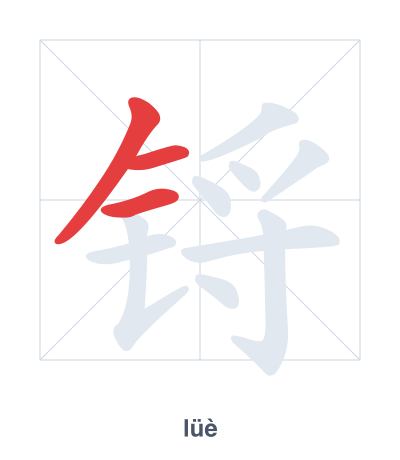
Open Hanzi Writer to see the animated stroke order and practice writing 锊 with real-time feedback.
The character 锊 (lüè) is written with 12 strokes. Follow the standard Chinese stroke order: top to bottom, left to right, outside before inside. The radical 钅 is one of its key components.
Practice the correct stroke order with the Hanzi Writer app to see animated stroke-by-stroke guidance with real-time feedback.
锊 means Lue (ancient unit of weight).
The character 锊 combines the metal radical 钅 (jīn, meaning 'metal' or 'gold') with the phonetic component 寽 (lüè, which originally depicted a hand grasping something). The metal radical indicates that this character relates to metal or precious materials, while the phonetic component provides the sound 'lüè'. Historically, 锊 referred to a unit of weight for gold or other metals in ancient China, reflecting the importance of precise measurement in trade and tribute.
💡 Memory Tip: Imagine a hand (寽) holding a piece of gold (钅) on a scale, measuring exactly one 'lüè' — a tiny but valuable unit of weight.
锊金是古代的重量单位。
lüè jīn shì gǔ dài de zhòng liàng dān wèi
Lue jin is an ancient unit of weight.
书里提到了锊子这个词。
shū lǐ tí dào le lüè zi zhè ge cí
The word 'lüèzi' is mentioned in the book.
古文中记载重六锊。
gǔ wén zhōng jì zǎi zhòng liù lüè
Ancient texts record a weight of six Lüe.
Open Hanzi Writer to see the animated stroke order and practice writing 锊 with real-time feedback.
✨ Animated stroke order · Handwriting recognition · HSK-graded practice · Free to use
锊 is a phono-semantic compound. The left part, 钅 (jīn), is the radical meaning 'metal' or 'gold', indicating that the character relates to metal or precious materials. The right part, 寽 (lüè), provides the pronunciation and originally depicted a hand grasping something, suggesting the action of taking or measuring. Together, they convey the idea of a specific amount of metal, like a unit of weight.