垆 (lú) means "black stiff soil" in Chinese. It has 8 strokes with the radical 土.
Rated 3.7/5 in difficulty (challenging).
Appears in 3+ common words including 酒垆 (jiǔ lú), 黄垆 (huáng lú), 垆土 (lú tǔ).
Due to its 8 strokes, Hanzi Writer's error detection shows 垆 requires focused practice — most learners need 10+ attempts for consistent accuracy.
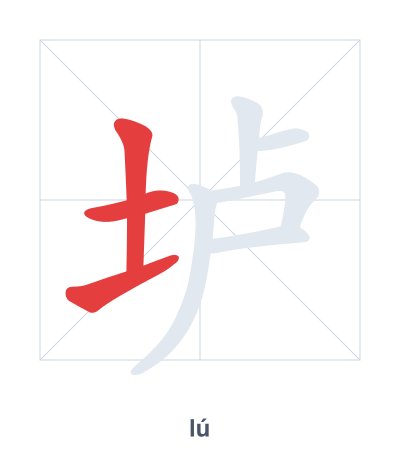
Open Hanzi Writer to see the animated stroke order and practice writing 垆 with real-time feedback.
The character 垆 (lú) is written with 8 strokes. Follow the standard Chinese stroke order: top to bottom, left to right, outside before inside. The radical 土 is one of its key components.
Practice the correct stroke order with the Hanzi Writer app to see animated stroke-by-stroke guidance with real-time feedback.
垆 means black stiff soil.
This compound character combines the radical 土 (earth, soil) with 户 (door) serving as a phonetic component. The meaning 'black stiff soil' comes from the earth radical, while the pronunciation lú derives from 户.
💡 Memory Tip: Picture a door (户) made of black, stiff soil (土) that is so hard you cannot push it open.
古代有很多酒垆。
gǔ dài yǒu hěn duō jiǔ lú
There were many wine shops in ancient times.
这里的土是黄垆。
zhè lǐ de tǔ shì huáng lú
The soil here is a stiff yellow clay.
这种垆土很肥沃。
zhè zhǒng lú tǔ hěn féi wò
This black soil is very fertile.
Open Hanzi Writer to see the animated stroke order and practice writing 垆 with real-time feedback.
✨ Animated stroke order · Handwriting recognition · HSK-graded practice · Free to use
垆 is composed of the radical 土 (earth, soil) on the left, and the phonetic component 卢 (lú, meaning "black" or an ancient vessel) on the right. The 土 radical directly links to the meaning of "soil", while 卢 provides the pronunciation and adds the nuance of being black-colored and stiff. Together, they form the idea of "black stiff soil".