眬 (lóng) means "dim-sighted; hazy" in Chinese. It has 10 strokes with the radical 目.
Rated 4.2/5 in difficulty (advanced).
Appears in 3+ common words including 朦眬 (méng lóng), 睡眼眬 (shuì yǎn lóng), 眬眬 (lóng lóng).
Due to its 10 strokes, Hanzi Writer's error detection shows 眬 requires focused practice — most learners need 10+ attempts for consistent accuracy.
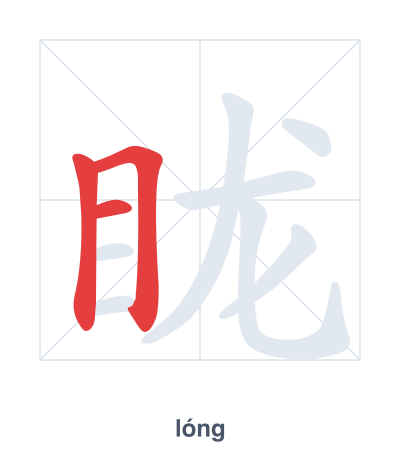
Open Hanzi Writer to see the animated stroke order and practice writing 眬 with real-time feedback.
The character 眬 (lóng) is written with 10 strokes. Follow the standard Chinese stroke order: top to bottom, left to right, outside before inside. The radical 目 is one of its key components.
Practice the correct stroke order with the Hanzi Writer app to see animated stroke-by-stroke guidance with real-time feedback.
眬 means dim-sighted; hazy.
The character 眬 combines the eye radical 目 with the phonetic component 龙 (dragon). Dragons in Chinese lore are often surrounded by mist and clouds, so the eye seeing through that haze becomes dim-sighted or blurry.
💡 Memory Tip: Imagine a dragon (龙) with cloudy eyes (目) that can barely see through the mist—it's completely dim-sighted.
他的泪眼朦眬。
tā de lèi yǎn méng lóng
His eyes were blurred with tears.
他睡眼眬地起床了。
tā shuì yǎn lóng dì qǐ chuáng le
He got out of bed with sleepy eyes.
月色看起来很眬眬。
yuè sè kàn qǐ lái hěn lóng lóng
The moonlight looks very dim.
Open Hanzi Writer to see the animated stroke order and practice writing 眬 with real-time feedback.
✨ Animated stroke order · Handwriting recognition · HSK-graded practice · Free to use
眬 is made of the radical 目 (eye) on the left and 龙 (dragon) on the right. The left part tells you the meaning is about eyesight, while the right part gives the pronunciation lóng. Together they describe a hazy or dim-sighted condition, like eyes that are not clear.