柃 (líng) means "Eurya (a genus of evergreen shrubs)." in Chinese. It has 9 strokes with the radical 木.
Rated 4/5 in difficulty (challenging).
Appears in 3+ common words including 柃木 (líng mù), 柃蜜 (líng mì), 柃花 (líng huā).
Due to its 9 strokes, Hanzi Writer's error detection shows 柃 requires focused practice — most learners need 10+ attempts for consistent accuracy.
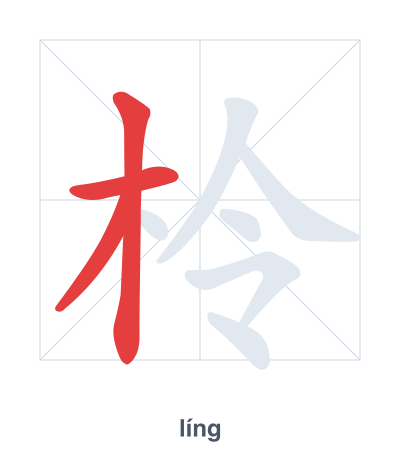
Open Hanzi Writer to see the animated stroke order and practice writing 柃 with real-time feedback.
The character 柃 (líng) is written with 9 strokes. Follow the standard Chinese stroke order: top to bottom, left to right, outside before inside. The radical 木 is one of its key components.
Practice the correct stroke order with the Hanzi Writer app to see animated stroke-by-stroke guidance with real-time feedback.
柃 means Eurya (a genus of evergreen shrubs)..
柃 is a compound character combining the radical 木 (tree) and the phonetic component 令 (líng). The wood radical indicates it is a type of tree or shrub, while 令 provides the pronunciation; this character specifically denotes the Eurya genus of evergreen shrubs.
💡 Memory Tip: Picture a tree (木) holding a command sign (令) that orders it to stay green all year, just like the evergreen Eurya shrub.
柃木是常绿植物。
líng mù shì cháng lǜ zhí wù
Eurya is an evergreen plant.
柃蜜的味道很香。
líng mì de wèi dào hěn xiāng
Eurya honey has a very fragrant aroma.
柃花在冬天开放。
líng huā zài dōng tiān kāi fàng
Eurya flowers bloom in winter.
Open Hanzi Writer to see the animated stroke order and practice writing 柃 with real-time feedback.
✨ Animated stroke order · Handwriting recognition · HSK-graded practice · Free to use
柃 is made up of the radical 木 (tree) on the left and the phonetic component 令 (líng) on the right. The 木 shows it is a type of plant or tree, and 令 gives the pronunciation. Together they mean a genus of evergreen shrubs called Eurya.