椋 (liáng) means "Starling / Dogwood" in Chinese. It has 12 strokes with the radical 木.
Rated 4.2/5 in difficulty (advanced).
Appears in 3+ common words including 椋鸟 (liáng niǎo), 灰椋鸟 (huī liáng niǎo), 椋木 (liáng mù).
Due to its 12 strokes, Hanzi Writer's error detection shows 椋 requires focused practice — most learners need 10+ attempts for consistent accuracy.
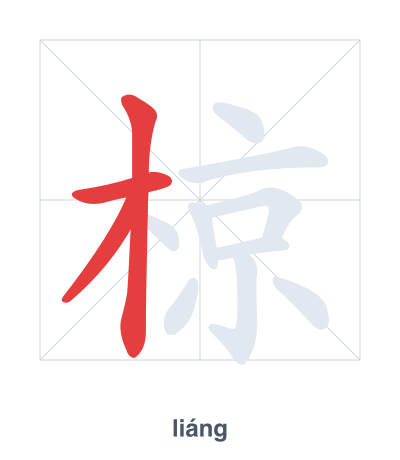
Open Hanzi Writer to see the animated stroke order and practice writing 椋 with real-time feedback.
The character 椋 (liáng) is written with 12 strokes. Follow the standard Chinese stroke order: top to bottom, left to right, outside before inside. The radical 木 is one of its key components.
Practice the correct stroke order with the Hanzi Writer app to see animated stroke-by-stroke guidance with real-time feedback.
椋 means Starling / Dogwood.
椋 is a phono-semantic compound, where 木 (tree) indicates it's a type of tree (dogwood), and 京 (capital city) provides the pronunciation liáng. The same character also refers to the starling bird, likely due to the bird's association with such trees or a phonetic loan.
💡 Memory Tip: Picture a tall dogwood tree (木) in the capital (京) where a flock of starlings loudly chirps at dusk.
树上有一只椋鸟。
shù shàng yǒu yī zhī liáng niǎo
There is a starling in the tree.
灰椋鸟在天空中飞。
huī liáng niǎo zài tiān kōng zhōng fēi
Grey starlings are flying in the sky.
这种家具是用椋木做的。
zhè zhǒng jiā jù shì yòng liáng mù zuò de
This furniture is made of dogwood.
Open Hanzi Writer to see the animated stroke order and practice writing 椋 with real-time feedback.
✨ Animated stroke order · Handwriting recognition · HSK-graded practice · Free to use
椋 is composed of the radical 木 (wood/tree) on the left and the phonetic component 京 (jīng, capital) on the right. The wood radical suggests this character relates to trees or wooden things, which connects to the dogwood tree meaning. The right part provides pronunciation, as 椋 is read liáng.