栗 (lì) means "Chestnut" in Chinese. It has 10 strokes with the radical 木.
Rated 4.2/5 in difficulty (advanced).
Appears in 3+ common words including 栗子 (lì zi), 板栗 (bǎn lì), 栗色 (lì sè).
Due to its 10 strokes, Hanzi Writer's error detection shows 栗 requires focused practice — most learners need 10+ attempts for consistent accuracy.
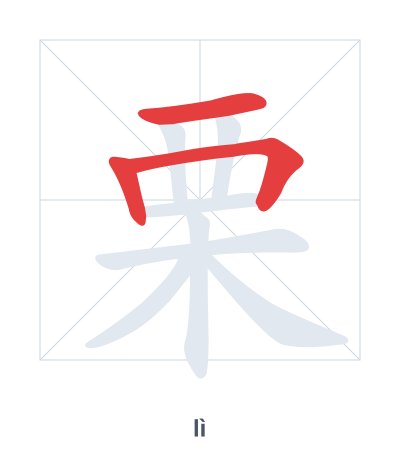
Open Hanzi Writer to see the animated stroke order and practice writing 栗 with real-time feedback.
The character 栗 (lì) is written with 10 strokes. Follow the standard Chinese stroke order: top to bottom, left to right, outside before inside. The radical 木 is one of its key components.
Practice the correct stroke order with the Hanzi Writer app to see animated stroke-by-stroke guidance with real-time feedback.
栗 means Chestnut.
The character 栗 is a compound of 木 (tree) and a pictograph of a chestnut burr (originally 㮚), showing a spiky fruit hanging from a tree branch. Ancient oracle bone forms depicted a tree with round, prickly clusters, representing the chestnut's spiny husk.
💡 Memory Tip: Picture a tree (木) with a spiky chestnut that looks like a tiny porcupine—if you step on it, you'll shout 'Lì!' (like 'ouch' in pain).
我喜欢吃糖炒栗子。
wǒ xǐ huān chī táng chǎo lì zi
I like eating sugar-roasted chestnuts.
妈妈买了一些板栗。
mā mā mǎi le yī xiē bǎn lì
Mom bought some chestnuts.
她的头发是栗色的。
tā de tóu fà shì lì sè de
Her hair is chestnut-colored.
Open Hanzi Writer to see the animated stroke order and practice writing 栗 with real-time feedback.
✨ Animated stroke order · Handwriting recognition · HSK-graded practice · Free to use
栗 is composed of a top part 覀 (a variant of 西 meaning 'west') and bottom part 木 (tree). The 木 radical indicates it's related to trees or wood, while the top may hint at the spiky husk of a chestnut fruit. Together, they represent a tree that produces chestnuts.