栎 (lì) means "oak" in Chinese. It has 9 strokes with the radical 木.
Rated 4/5 in difficulty (challenging).
Appears in 3+ common words including 栎树 (lì shù), 栎木 (lì mù), 栎林 (lì lín).
Due to its 9 strokes, Hanzi Writer's error detection shows 栎 requires focused practice — most learners need 10+ attempts for consistent accuracy.
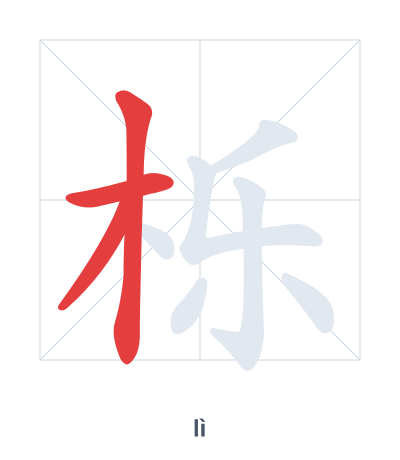
Open Hanzi Writer to see the animated stroke order and practice writing 栎 with real-time feedback.
The character 栎 (lì) is written with 9 strokes. Follow the standard Chinese stroke order: top to bottom, left to right, outside before inside. The radical 木 is one of its key components.
Practice the correct stroke order with the Hanzi Writer app to see animated stroke-by-stroke guidance with real-time feedback.
栎 means oak.
The character 栎 combines the tree radical 木 (wood) with 乐 (music/joy) as a phonetic component. Oak wood was historically prized for making musical instruments, linking the sound of 乐 to this sturdy tree.
💡 Memory Tip: Imagine an oak tree (木) with musical notes (乐) growing from its branches, since its wood makes beautiful instruments.
栎树长得很高大。
lì shù zhǎng dé hěn gāo dà
Oak trees grow very tall and large.
栎木可以用来做家具。
lì mù kě yǐ yòng lái zuò jiā jù
Oak wood can be used to make furniture.
我们走进了一片栎林。
wǒ men zǒu jìn le yī piàn lì lín
We walked into an oak forest.
Open Hanzi Writer to see the animated stroke order and practice writing 栎 with real-time feedback.
✨ Animated stroke order · Handwriting recognition · HSK-graded practice · Free to use
栎 is composed of the radical 木 (tree/wood) on the left and the component 乐 on the right. The radical 木 shows that this character belongs to the category of trees, specifically the oak tree. The right part 乐 originally provides a phonetic hint, though the pronunciation differs slightly from its usual reading.