坜 (lì) means "ditch / trench" in Chinese. It has 7 strokes with the radical 土.
Rated 3.5/5 in difficulty (challenging).
Appears in 3+ common words including 坑坜 (kēng lì), 坜上 (lì shàng), 坜边 (lì biān).
Due to its 7 strokes, Hanzi Writer's error detection shows 坜 requires focused practice — most learners need 10+ attempts for consistent accuracy.
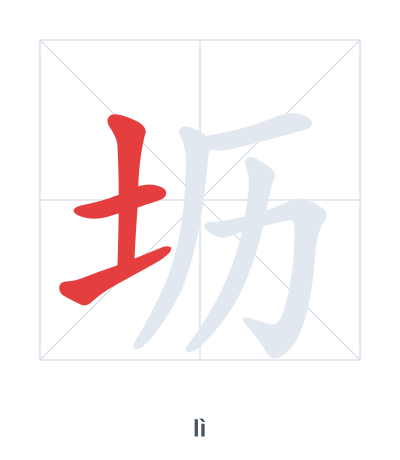
Open Hanzi Writer to see the animated stroke order and practice writing 坜 with real-time feedback.
The character 坜 (lì) is written with 7 strokes. Follow the standard Chinese stroke order: top to bottom, left to right, outside before inside. The radical 土 is one of its key components.
Practice the correct stroke order with the Hanzi Writer app to see animated stroke-by-stroke guidance with real-time feedback.
坜 means ditch / trench.
The character 坜 is a compound of the radical 土 (earth) and the phonetic component 历 (lì, meaning 'to pass through'). Together, they suggest a channel or trench that passes through the earth to drain water.
💡 Memory Tip: Imagine a plow (历) cutting a deep groove through the soil (土), forming a drainage ditch.
这里有很多坑坜。
zhè lǐ yǒu hěn duō kēng lì
There are many pits and hollows here.
他在坜上走着。
tā zài lì shàng zǒu zhe
He is walking on the path.
坜边有一棵树。
lì biān yǒu yī kē shù
There is a tree by the ditch.
Open Hanzi Writer to see the animated stroke order and practice writing 坜 with real-time feedback.
✨ Animated stroke order · Handwriting recognition · HSK-graded practice · Free to use
The character 坜 is made of two parts: the left radical 土 (earth or soil) and the right component 历 (lì, which gives the sound). The 土 part shows that the meaning relates to the ground, while the right side acts as a phonetic hint. Together, they form the meaning of a ditch or trench dug in the earth.