柯 (kē) means "branch or stem" in Chinese. It has 9 strokes with the radical 木.
Rated 4/5 in difficulty (challenging).
Appears in 3+ common words including 柯南 (kē nán), 柯基 (kē jī), 南柯一梦 (nán kē yī mèng).
Due to its 9 strokes, Hanzi Writer's error detection shows 柯 requires focused practice — most learners need 10+ attempts for consistent accuracy.
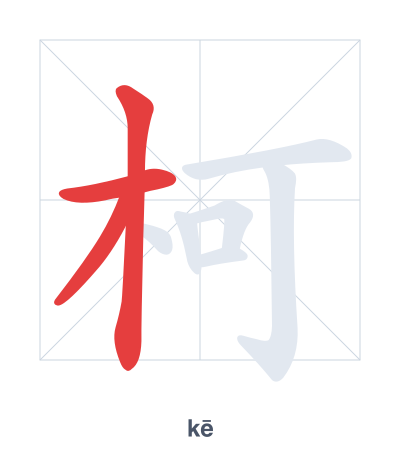
Open Hanzi Writer to see the animated stroke order and practice writing 柯 with real-time feedback.
The character 柯 (kē) is written with 9 strokes. Follow the standard Chinese stroke order: top to bottom, left to right, outside before inside. The radical 木 is one of its key components.
Practice the correct stroke order with the Hanzi Writer app to see animated stroke-by-stroke guidance with real-time feedback.
柯 means branch or stem.
柯 is a phono-semantic compound combining the radical 木 (tree, indicating the meaning of wood or branch) with the phonetic element 可 (kě, providing the sound kē). The character specifically refers to a branch or stem connected to the trunk.
💡 Memory Tip: Imagine a tree (木) with a branch shaped like the character 可, as if the branch is saying 'OK, I can (可) hold you.'
他很喜欢看柯南。
tā hěn xǐ huān kàn kē nán
He likes watching Detective Conan.
我家养了一只柯基。
wǒ jiā yǎng le yī zhī kē jī
I have a Corgi.
这一切都是南柯一梦。
zhè yī qiè dōu shì nán kē yī mèng
All of this was just a fleeting dream.
Open Hanzi Writer to see the animated stroke order and practice writing 柯 with real-time feedback.
✨ Animated stroke order · Handwriting recognition · HSK-graded practice · Free to use
The left side is the radical 木 (tree), which hints at the meaning "branch or stem." The right side is 可 (kě), which provides the sound and adds no direct meaning but completes the phonetic-semantic compound structure.