铠 (kǎi) means "Armor" in Chinese. It has 11 strokes with the radical 钅.
Rated 4.2/5 in difficulty (advanced).
Appears in 3+ common words including 铠甲 (kǎi jiǎ), 铁铠 (tiě kǎi), 铠装 (kǎi zhuāng).
Due to its 11 strokes, Hanzi Writer's error detection shows 铠 requires focused practice — most learners need 10+ attempts for consistent accuracy.
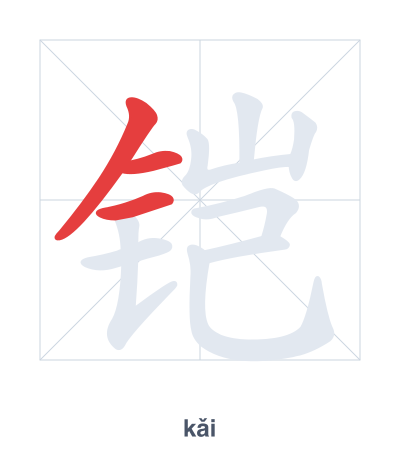
Open Hanzi Writer to see the animated stroke order and practice writing 铠 with real-time feedback.
The character 铠 (kǎi) is written with 11 strokes. Follow the standard Chinese stroke order: top to bottom, left to right, outside before inside. The radical 钅 is one of its key components.
Practice the correct stroke order with the Hanzi Writer app to see animated stroke-by-stroke guidance with real-time feedback.
铠 means Armor.
铠 is a phono-semantic compound. The radical 钅 (metal) indicates that armor is made of metal, while the component 岂 (qǐ) provides the pronunciation. Though 岂 originally means 'how' or 'why,' it contributes sound rather than meaning here.
💡 Memory Tip: Picture a metal suit of armor (钅) with a mountain-shaped (山) chest plate strapped on with a belt (己).
士兵穿着铠甲。
shì bīng chuān zhe kǎi jiǎ
The soldier is wearing armor.
铁铠非常重。
tiě kǎi fēi cháng zhòng
Iron armor is very heavy.
这是铠装电缆。
zhè shì kǎi zhuāng diàn lǎn
This is an armored cable.
Open Hanzi Writer to see the animated stroke order and practice writing 铠 with real-time feedback.
✨ Animated stroke order · Handwriting recognition · HSK-graded practice · Free to use
铠 is a phono-semantic compound. The left radical 钅 (metal) indicates that armor is made of metal, while the right side 岂 (kǎi) provides the pronunciation. Together, they create the meaning of "armor."