榉 (jǔ) means "Beech" in Chinese. It has 13 strokes with the radical 木.
Rated 4.2/5 in difficulty (advanced).
Appears in 3+ common words including 榉木 (jǔ mù), 榉树 (jǔ shù), 榉木桌 (jǔ mù zhuō).
Due to its 13 strokes, Hanzi Writer's error detection shows 榉 requires focused practice — most learners need 10+ attempts for consistent accuracy.
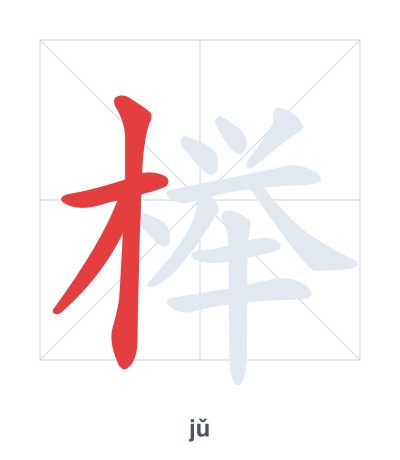
Open Hanzi Writer to see the animated stroke order and practice writing 榉 with real-time feedback.
The character 榉 (jǔ) is written with 13 strokes. Follow the standard Chinese stroke order: top to bottom, left to right, outside before inside. The radical 木 is one of its key components.
Practice the correct stroke order with the Hanzi Writer app to see animated stroke-by-stroke guidance with real-time feedback.
榉 means Beech.
The character 榉 is a compound of 木 (tree) as the semantic radical and 举 (jǔ, meaning 'to lift') as the phonetic component. The beech tree is known for its tall, straight trunk that seems to reach upward, echoing the idea of lifting.
💡 Memory Tip: Imagine a beech tree (木) so tall you must lift (举) your head high to see its top.
榉木很坚硬。
jǔ mù hěn jiān yìng
Beech wood is very hard.
公园里有榉树。
gōng yuán lǐ yǒu jǔ shù
There are beech trees in the park.
这是榉木桌子。
zhè shì jǔ mù zhuō zi
This is a beechwood table.
Open Hanzi Writer to see the animated stroke order and practice writing 榉 with real-time feedback.
✨ Animated stroke order · Handwriting recognition · HSK-graded practice · Free to use
榉 is a phono-semantic compound. The left part 木 (tree) indicates it is about a type of tree or wood, and the right part 举 (jǔ, meaning 'to lift') gives the pronunciation. Together they form a character meaning 'beech tree'.